Decrim for SAfety

Kate McGrew, current sex worker and director of the Sex Workers Alliance Ireland (SWAI), said “The Sex Workers Alliance are horrified to learn of the jailing of two sex workers at Naas District Court yesterday, one of whom is pregnant, less than one week after International Sex Workers Day. The facts of this case show the 2017 Sexual Offences Law is not fit for purpose. There were no clients present, very little money and no evidence of the workers being coerced in to their job.”

She continued “The change in law in 2017 was heralded as a law that would protect sex workers. But we at SWAI cannot understand how jailing two young migrant women will protect or rescue them in any way. Their crime, for working together for safety, is not a violent crime and there are no victims. 

“Prior to the change in law in 2017 the maximum sentence for so-called brothel keeping was 6 months. When misinformed politicians and policymakers speak about how the law has decriminalised workers they completely ignore that sex workers working together for safety risk increased penalties. We repeat: the Nordic Model does not decriminalise sex workers. This is not justice gone wrong, this is how the law was designed to work. 

“Even those who support the law cannot support the prosecution of two women under these laws. We in SWAI feel this is an egregious waste of Garda time and resources. These are two women working together, whose apartment was put under surveillance by the Gardai. 

“When we fought last year to repeal the 8th amendment we spoke of care and compassion for those who are pregnant. Are we really ready to stand over the jailing of a young pregnant migrant who was working together with another woman for safety? Is this the justice system we want for our country? We have a long and shameful past of institutionalising ‘fallen women’. The clear contempt in the way the judge spoke to and about these women is very reminiscent of our dark history of Magdalene laundries and Mother and Baby homes.  

“Sex workers want to be safe and we want to trust the state and its services in upholding our rights. But cases like this erode the already precarious trust that workers have in state services. Next year, there will be a three year review of the 2017 Sexual Offences Act. The Sex Workers Alliance will be calling for full decriminalisation of sex workers in the review.”

#DecrimforSafety #SupportSafeSexWork.
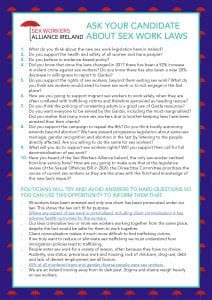
In less than 2 weeks we take to the polls again to vote for politicians to represent us on a local and European level. Sex workers are rarely heard by politicians so WE NEED YOUR HELP! Please ask your candidates about what they will do to help sex workers. Many politicians will not have considered sex work outside of Ending Demand so we need to change that.

Ask your candidate about sex work laws
  1. What do you think about the new sex work legislation here in Ireland?
  2. Do you support the health and safety of all women and trans people?
  3. Do you believe in evidence-based policy?
  4. Did you know that since the laws changed in 2017 there has been a 92% increase in violent crime against sex workers? Do you know there has also been a near 20% decrease in willingness to report to Gardai?
  5. Do you support the rights of sex workers, beyond them exiting sex work? What do you think sex workers would need to leave sex work or to not engage in the first place?
  6. How are you going to support migrant sex workers to work safely, when they are often conflated with trafficking victims and therefore perceived as needing rescue?
  7. Do you think the policing of consenting adults is a good use of Garda resources? Do you want everyone to be served by the Gardaí, including the most marginalised? Did you realise that many more sex workers due to brothel-keeping laws have been arrested than their clients?
  8. Did you support the campaign to repeal the 8th? Do you think bodily autonomy extends beyond abortion? We have passed progressive legislation about same-sex marriage, gender recognition and abortion in the last by listening to the people directly affected. Are you willing to do the same for sex workers?
  9. What will you do to support sex workers rights? Will you support their call for full decriminalisation of sex work?
  10. Have you heard of the Sex Workers Alliance Ireland, the only sex-worker centred front-line service here? How are you going to make sure that at the legislative review of the Sexual Offences Bill in 2020, the Oireachtas Committee prioritizes the voices of current sex workers as they are the ones with the first-hand knowledge of this new law’s impact?
Politicians will try and avoid answers to hard questions so you can use this opportunity to inform them that:
  • 55 workers have been arrested and only one client has been prosecuted under our law. This shows the law isn’t fit for purpose.
  • Where any aspect of sex work is criminalised, including client criminalisation it has adverse health outcomes for the workers.
  • Our laws criminalise two or more sex workers working together from the same place, despite the fact would be safer for them to work together.
  • Client criminalisation makes it much more difficult to find trafficking victims.
  • If we truly want to reduce or eliminate sex trafficking we must understand how immigration policies lead to trafficking.
  • People enter sex work for a variety of reason, often because they have no choice. Austerity, visa status, precarious work and housing, lack of childcare, drug-use, debt and lack of decent employment are all factors.
  • 65% of all murdered trans and gender diverse people were sex workers.
  • We are an Ireland moving away from its dark past. Stigma and shame weigh heavily on sex workers.

We’ve made a handy printable pdf for you to stick up on the back of your door so you have it ready to question your candidate. 

Candidate checklist

Justice for sex workers is rare but there is hope, says Sex Workers Alliance Ireland

Today the Dublin Circuit Criminal Court found a man guilty of serial violent sexual assaults on sex workers in 2017. 

Kate McGrew, director of SWAI and current sex worker says “We all expect laws to keep us safe. Before the law introducing criminalisation of the purchase of sex in 2017, sex workers and our allies warned misinformed politicians and the state that this will see an increase in violence against sex workers. Since the law changed we have seen a 92% increase in violent crimes against sex workers.

She continued “As the first point of contact for these victims we encouraged and supported them through this process while liaising with the Gardaí. As a result of the bravery of these women, this man has now been prosecuted. We are heartened to see that our work and liaising with Gardaí have resulted in a conviction. It is all too rare for sex workers to get justice.”

“When people are attacked or assaulted one of the first steps they will take is reporting to the Gardaí. When you are a sex worker you have to weigh this up against the threat of deportation, future surveillance or even mockery by the Gardaí. Many workers never report assaults and have a long-standing mistrust of the Gardaí. Sex workers must feel safe to report without scrutiny or judgement on their livelihood and residence.

Today’s case gives us and sex workers working in Ireland hope that they can report Gardaí and find paths to justice. We are heartened to see stretched Garda resources being used to prosecute those who are attacking vulnerable women. We reiterate our call to decriminalise sex work so that workers feel safe in reporting to the Gardaí. We call for the end of criminalisation of the purchase of sex and women working together in pairs for safety. As always we are here for any sex worker who needs us, regardless of circumstance. Please call us on 085 824 9305.”

#DecrimforSafety #SupportSafeSexWork.
Gardaí should protect the most vulnerable. Instead our laws put marginalised people in danger and waste precious Garda resources.  

Kate McGrew, director of SWAI and currently working sex worker said “36 men have been questioned over purchase of sex in the past few days and, while this is a huge number this is still far less than the 55 workers who have been prosecuted for working together in safety*, so called brothel-keeping. Of these 36 men we don’t know how many, if any, will be prosecuted. All the while there has been a 92% increase in violent crime against sex workers since the 2017 laws came in. This is where Garda resources should be directed”

She continued “While we don’t know the details of the cases, the press release from the Gardaí reads like there was mass surveillance on workers. The outcome of this will mean that clients will not use their real names or phone numbers to evade detection. This puts workers at a very real risk as they will be less able to screen predators. They may also insist that workers come to them, taking the worker out of their security zone and into somewhere unknown. Sex workers are now forced to work in isolation, which puts them at further risk of violence and exploitation.  Ultimately sex worker will be driven further underground, which does nothing to help the minority of trafficked people working in sex work in Ireland. 

“There is nothing in the Garda statement about the workers. We don’t know if they are safe, or whether they were coerced or consenting adults. Sex work is a particular type of work that people do when they have few other options. The law does not help them. Workers will be forced to take risks to make ends meet. Questioning and arresting clients is, in fact, not support for sex workers and is a terrible use of stretched Garda resources. Mass surveilance of sex workers leads to distrust in the Gardaí, making workers less likely to report when they have been assulated.”

“The bottom line is these actions reported today are not support. The actions by the Gardaí over the past few days and the resources spent on them do nothing to help sex workers, should they want to leave sex work. In the past we have worked with the Gardaí and workers who were violently attacked to bring those perpetrators to justice.  During the period of escalated violence that has followed the 2017 change in law, SWAI has been increasingly involved on the ground with helping workers on the ground in emergency situations. In our interactions with the Gardaí, even when they are dealing with workers who have been attacked, it is clear that they are overstretched. We fear that actions such as those reported today will mean a loss of trust in the Gardaí. We would like to see Garda efforts focus on actually helping sex workers when they are the victims of a crime, instead of meddling with their means of survival.”

The Sex Workers Alliance Ireland, the only sex worker led front-line organisation in Ireland, want to see sex work decriminalised. Studies have shown that where any aspect of sex work is criminalised it means increased violence and adverse health conditions for the worker**. The 2017 law does nothing to address the precarity and lack of security that can lead to human trafficking. One of the big reasons we need full decriminalisation in Ireland is to improve relations with Gardai, so that those on the ground – sex workers and clients alike – can easily report exploitation, abuse, and trafficking without repercussion. We ask that misinformed politicians listen to us, the very people who are materially affected by these laws. Who are these laws helping? Sex workers want to be safe, like everyone else. 

#DecrimforSafety #SupportSafeSexWork.
W deserve Healthcare free from stigmaWe all deserve to work in safety, access health services and paths to justice. Since the enactment of the 2017 law, sex workers are less safe. Violent crime against sex workers has increased by 92% in the past 2 years. 

Kate McGrew, sex worker and director of Sex Workers Alliance Ireland (SWAI) says “We deserve to be safe but instead of decreasing demand the laws have created a buyers market, where the purchasers of sex hold the power. This in direct opposition to what we were told was the intention of the law. Sex workers are not decriminalised. The penalties of sex workers sharing premises together, also known as brothel keeping, has doubled since the introduction of the new Sexual Offences Bill in 2017. Sex workers are now forced to work in isolation, which puts them at further risk of violence and exploitation. Since the law has been introduced many more sex workers have been arrested than clients. We want sex work decriminalised so that the power gets put back in the hands of the worker.”

She adds “Security and safety matter to sex workers too. When the laws changed in 2017 we saw a marked increase in violent crime. We supported several trans migrant sex workers after a spate of serial attacks. If we are attacked we want to rely on the Gardaí to help us and to apprehend our attackers. Sex workers are afraid to report crimes to Gardai, in fear their workplace will then be surveilled to catch their clients. The law means sex workers see Gardai don’t have their best interests at heart, as they need to enforce the laws. The current law diverts much-needed resources away from community policing and into policing what happens between consenting adults.”  

“Sex workers can be an ally in the fight against trafficking, but right now we feel we cannot approach the Gardaí with information because we will be surveilled, or worse, deported. This new law does nothing to solve human trafficking.” Kate Continues. “Everyone is worthy of a life without oppression and coercion, including sex workers. Workers that have been caught up in brothel raids have been asked to leave the country. Where are the oversight and compassion? How does that solve human trafficking?

We want to be safe in our jobs. Since the laws have been enacted workers have lost negotiating power with their clients. Ending demand has led to a drop in prices, increased risk-taking such as taking clients that they feel aren’t safe or not using a condom. In Ireland rates of HIV are rising. Sex workers are at increased risk of HIV but with stigma perpetuated by state bodies and misguided politicians, workers may not attend services provided for them. Trans and vulnerable migrant workers bear the brunt of this and fall through the cracks. We need services fit for purpose.

In Ireland, in the past year, we have monumental strides away from our dark past of Magdeline laundries and hiding women away in shame. We succeeded in repealing the 8th amendment by having difficult conversations about taboo topics. We asked the country to listen and they did. Now we ask misinformed politicians to listen to us. 

We are the currently working sex workers in this country. We are the experts in our lives and we are telling you that these laws are damaging. We are calling on the government to decriminalise sex work fully in the 2020 review and make sex workers safe.” 

#DecrimforSafety #SupportSafeSexWork

Inernational Sex Workers Rights DayToday, the 3rd of March is International Sex Workers Rights Day. The Sex Workers Alliance Ireland (SWAI) is the only sex workers rights groups in Ireland who places currently working sex workers at the heart of the campaign. We are also the only sex worker group in the country that supports male and trans sex workers, as well as female sex workers. 

Kate McGrew, director of Sex Workers Alliance Ireland (SWAI) says “In 2017, despite warnings from us and other bodies in Ireland misguided politicians proceeded to change the laws and adopt what is known as the Swedish model of client criminalisation. Since that time there has been a 77%  increase in violence against sex workers. ” 

She continues “Penalties for workers working in pairs or groups doubled was a change in law that happened quietly, but it is an extremely dangerous piece of legislation. There will be a review of the law in 2020 and we will be centering the voices of currently working and former sex workers. These laws make sex workers unsafe. When 50 workers have been prosecuted under the laws but only two men we can see how these laws are being used against the people they are supposed to save and are not fit for purpose. 

For sex workers, the police are vectors of violence, not of safety or harm reduction. Migrant sex workers, already on the margins of society, are the targets of these raids and are offered the choice of leaving the country or face prosecution and possibly deportation. These strategies only serve to move the sex workers on and no interaction with support services or assistance is offered. 

There is a mounting body of evidence that full decriminalisation of sex work is the only way to keep sex workers safe and ensure that we have full access to justice and supports. By pushing sex workers to the margins and criminalising their work we leave workers open to exploitation from 3rd parties.” 

Sex workers are tired of being spoken about, not spoken to. Misinformation and use of stereotypes about sex workers used in the media damage the safety and their opportunities to access rights. 

Bella, sex worker based in Dublin says “I am proud of being a sex worker. My profession has allowed me to follow my dreams and overcome the extreme poverty I came from. Class oppression made me bow down to the more powerful many times over in my life. Thanks to sex work I am independent and stronger. I don’t need to be saved, I don’t need to be rescued. We have a voice, we can speak for ourselves!”

Today, on International Sex Workers Rights Day we join many sex worker-led organisations around the world in calling for full decriminalisation fo sex worker in Ireland. We would also like to remind sex workers that we are here for peer-led, non-judgemental support.” 

Zero Discrimination Day

We are highlighting the laws surrounding sex work in Ireland as discriminatory laws today on the UNAIDS Zero Discrimination Day. This year UNAIDS are using Zero Discrimination day to draw attention to the many laws which create barriers to health and safety, as well as many other human rights breaches. 

Kate McGrew, director of Sex Workers Alliance Ireland (SWAI) says “We all deserve to have health and safety but laws which police sexual expression, including transactional sex between consenting adults, lead to already marginalised people being pushed further into the margins. When sex workers, who in Ireland are mostly migrants, cannot work together in safety they take greater risks, such as shorter negotiations or lack of use of condoms. Stigma and shame lead to sex workers not attending services such as rape crisis centres or seeking justice if they have been a victim of a crime.” 

She continues “In 5 countries in the world the possession of condoms is “proof” that a person is engaged in sex work. In Ireland we hear from workers that Gardai routinely take condoms as evidence of sex work as well as any money made, during a brothel raid, even when they do not make any arrests and only tell the women to move on. This leaves the workers with no money to travel and with no safe way to make money to do so. Sex workers, and trans workers in particular, are at high risk for HIV and any law that makes them less likely to practice safe sex or get tested has a detrimental effect on an already vulnerable population.

Misguided politicians have been led ot believe that our laws save sex workers, but instead they put them in harms way. SWAI is the only sex workers rights group in Ireland that puts sex workers at the centre of their policy. We join many other sex workers rights groups in calling for full decriminalisation of sex work, including clients, so that workers can have healthy and safe lives free from stigma” 

Ugly Mugs logo

SWAI is extremely concerned for the safety of sex workers in Ireland, as Ugly Mugs a widely used by sex workers has been rejected by Google to allows its app to screen calls and texts. This app screens calls and text for dangerous clients. Ugly Mugs applied for an exemption to new rules by Google to clamp down on apps, that require phone and sms permissions, but Google rejected its application.

This app is used by sex workers all over Ireland on a daily basis and they rely on it to keep them safe. It is extremely concerning that an app, which keeps sex workers safe from dangerous clients and has helped prevent many attacks on sex workers is having one of its keys means to keep sex workers safe being removed from the app.

Catriona, a sex worker “I use this app all the time and honestly without it I would probably be beaten or robbed. This is something I don’t say lightly, but my safety has been indispensable to the existent of this app. I am really worried for myself and my colleagues, that such an important part of the app is being removed.”

Kate McGrew, director of SWAI says “Sex workers, and trans workers in particular, are some of the most vulnerable people on the planet. Sex work is not illegal in Ireland, but working together with another worker is. What little safety nets we have are being eroded. 

We all deserve to work in safety and removing this feature from Ugly Mugs will be put in danger because of this issue. Google need to step up and do the right thing so that we can continue to remain safe”

Sex Workers Want Rights Not Rescueess releasem

Kate McGrew, director of Sex Workers Alliance Ireland (SWAI) says “This man was caught procuring sex during a raid on a so-called brothel, when two or more workers work together. This case yet against highlights how the law is being used against workers who may want to work together for safety reasons. This man was collateral damage in an ill-fated war to end demand. He was not the intended target of the raid, the workers were.” 

She continues “As a result of this prosecution workers will be forced to work alone, which increases their vulnerability. Working or living with another sex worker is illegal in Ireland. Penalties doubled for workers working in pairs or groups when the law change and this change in law happened quietly, but it is an extremely dangerous piece of legislation. The Nordic model purportedly is meant to target the client but by this law, but if we want to work legally here we are forced to work alone. Violent attacks specifically increased on us 77% in the first year of the law being introduced. This is not a coincidence.” 

“This is the first prosecution of a client under the laws brought in in 2017, but from statistics we go from the Central Statistics office we know 55 people have been arrested. We can only conclude that the rest of those prosecuted under brothel keeping laws are the workers themselves. Is this really what this law was introduced for?” 

“For sex workers the police are vectors of violence, not of safety or harm reduction. Many migrant sex workers, already on the margins of society, are offered the choice of leaving the country or face prosecution and possibly deportation. When anti-sex work organisations speak about all sex work being violence, including the consensual transactions, what recourse do we have when we are actually assaulted?”

“No one is asking about the sex workers who have been caught in this raid. We hope they are safe and getting the support they need and we would like to remind them and all other sex workers that we are here for peer-led, non judgemental support for all sex workers”

End Violence Against Sex Workers

While new report shows that Sex Workers working even in partially criminalised settings face three times the amount of violence, it remains completely illegal for two workers to work together for safety in Ireland.

Today is International Day to Eliminate Violence Against Sex Workers. In a year of difficult conversations which challenged the status quo and led to real gains for women and people who can get pregnant in Ireland, we must continue to push further to ensure bodily autonomy and the safety of everyone, including sex workers.  

Kate McGrew, director of Sex Workers Alliance Ireland (SWAI) says “Penalties for workers working in pairs or groups doubled was a change in law that happened quietly, but it is an extremely dangerous piece of legislation. The Nordic model purportedly is meant to target the client but by this law, but if we want to work legally here we are forced to work alone. Violent attacks specifically increased on us 77% in the first year of the law being introduced. This is not a coincidence.” 

She continues “We talk to worker after worker whose safety and income has become increasingly precarious. Many are forced to seek assistance for housing by criminals who prey upon our vulnerability. In a time of housing crisis we are exploited by landlords who take advantage of our brothel keeping laws to extract enormous sums for use of their property. 

Trans sex workers of colour are some of the most vulnerable people in the world. Sex work is one of the few avenues of income open to trans people. While we have quite progressive law on gender recognition in Ireland employment opportunities are rare. Until proper supports are put in place for everyone people will still continue to see sex work as their opportunity for independence and income. 

The officers who arrest us are the ones we are to report to if we are assaulted. For sex workers the police are vectors of violence, not of safety or harm reduction. Many migrant sex workers, already on the margins of society, are offered the choice of leaving the country or face prosecution and possibly deportation. When anti-sex work organisations speak about all sex work being violence, including the consensual transactions, what recourse do we have when we are actually assaulted?

We see reports published that back up what we have known anecdotally for years; that when any aspect of sex work is criminalised, including the purchase of sex, violence against sex workers is normalised. We want sex work decriminalised so that we are no longer pushed to the margins. How long can some feminist organisations, the government and the health department ignore the growing body of evidence that shows that their policies are damaging our health?”