Harm reduction, sex work and Covida-19

For sex workers

As sex workers ourselves, we know that when everyone is being told to isolate our work gets hit. If you can take some time off to stop working and social distance now is a good time. 

We also know that some people will need to work to survive. This blogspot outlines a harm reduction approach to sex work during the coronavirus. Do the best you can, that is all anyone can do and you are the best person to make decisions about the reality of your life.

Covid-19 spreads through droplets when a person sneezes or coughs. The virus has a long incubation period so people can transmit without showing symptoms. The safest possible scenario is to keep a distance from others of two to three meters. We know this makes most of our work impossible! So, some suggestions for safer work during this time are:

  • Refraining from kissing and insist on condom-covered services including for blowjobs and dental dams for rimming.
  • Positions like doggy style or reverse cowgirl are better to limit contact and make sure you and your client take long hot showers before and after.
  • Make sure your client washes his hands for 20 seconds upon entry, and when he has left clean all surfaces that he has touched (including doorknobs and handles) with soap and water. Anti-bacterial wipes are okay, soap and water is better.
  • Try not to touch your own face as this is the way the virus enters the body.
  • Take extra care to wash any sex toys that are used
  • Wash your hands for 20 seconds or longer between each client, after being outside and after handling money 
  • Do not do in-person sex work with a client who is displaying symptoms of the virus
  • Do not do in-person sex work if you are displaying symptoms of the virus
  • Each worker charges according to her situation but if possible do not drop your prices. Remember that for your client this is leisure but for you, it’s your livelihood

We know us sex workers are already very good at protecting our health, we just have to be extra careful at this moment!

Please note that there is now a firewall between immigration and the department of health so even if you are undocumented you can still contact a doctor if you have symptoms of the coronavirus.

If you need anything from SWAI, even just for a chat please get in contact with us. We would love to hear from you. 

For clients

Please note that sex workers have always been impeccable when it comes to hygiene. 

  • If possible try to seek remote sexual services such as video or phone sex. Please note that this may not always be possible
  • Ensure your hygiene is exemplary. Note that you are responsible for your own health
  • Wash your hands immediately for 20 seconds or more when entering the premises
  • If running water is not available please use hand sanitiser
  • You should always respect the boundaries a sex worker has but now please do so for your own safety
  • Tip generously, sex workers are always impeccable about hygiene but are taking a risk to see you
  • Wear a condom for all sex acts (without complaint!)
  • Do not seek the services of a sex worker if you are displaying symptoms of the virus
  • Do not be racist to members of the Asian community
For allies
  • Do not stigmatise or judge a worker who keeps working, it can mean the difference between having food to eat or not
  • Do not be racist to members of the Asian community

Stethoscope Kate McGrew current sex worker, director of The Sex Workers Alliance Ireland (SWAI) and co-convenor of the European Network for Sex Workers’ Rights (ICRSE) is calling for the Irish government to urgently act to ensure that sex workers, along with their families and communities, can access social protections during the COVID-19 pandemic. She says “As more countries impose lockdowns, self-isolation and travel restrictions many sex workers will lose most, or all, of their income and face financial hardship, increased vulnerability, destitution or homelessness. The clandestine nature of sex work also means that many will be unable to access the safeguards provided for other workers, such as sick pay.” 
She continues “Many sex workers come from communities that already face high levels of marginalisation and social exclusion including women living in poverty, migrants and refugees, trans people and drug users. Sex workers who are the primary earners in their families, or who don’t have alternative means of support are at risk of being forced into more precarious and dangerous situations to survive. 

Sex workers in Ireland are already reporting: 

  • Drastic loss of income 
  • Closure of workplaces 
  • Lack of funds to pay for basic needs, support family members and dependents
  • Inability to access community  health services which have shut down or decreased their activities
  • Increased pressure to take risks while working in order to secure income 

This pandemic is revealing, with extreme urgency, the ways in which sex workers are forced to operate on the margins, in precarious circumstances, without the protections enjoyed by other workers. 

SWAI and ICRSE support efforts by governments to control transmissions of the virus. However, public health measures that do not consider the circumstances of the most marginalized groups put their overall success at risk. In providing emergency measures and relief, governments must ensure that they reach workers who are excluded from the formal economy. 

As minimum governments must urgently provide:

  • Immediate, appropriate and easy-to-access financial support for sex workers in crisis,
  • Emergency housing for homeless sex workers
  • A firewall between immigration authorities and health services
  • Access to health care for all sex workers, irrespective of their immigration status

All measures related to sex work must be based on public health and human rights principles and be developed in consultation with sex workers and their organisations to limit their negative impact. This unprecedented crisis calls for meaningful collaboration between all sectors of society, including those most marginalized. Only by involving sex workers do governments stand a chance to limit the pandemic and eventually end it.

To mitigate the harm of the pandemic on sex workers we have set up a hardship crowdfund. Sex work is work and sex workers like many precarious workers have been affected by Covid-19. This money will go directly into the hands of sex workers through individual emergency payments. Here is the link: https://swai-hardship-fund.causevox.com/

Sex workers are not the problem, we are part of the solution”

#DecrimforSafety #SupportSafeSexWork

SWAI Hardship Fund

SWAI Hardship Fund

On Saturday 21st March the Sex Workers Alliance Ireland launched our crowdfund to ensure that some of society’s most vulnerable people can survive. 

All non-essential workplaces have closed and people are being advised to stay indoors and to ‘social distance’ from each other. This is having a particular impact on the sex industry. Already sex workers are seeing a dramatic decrease in clients. Clients are staying away, hotels are closing or at least disallowing non-residents in, and university students are being evicted in swaths if they are in student housing, in order to keep people apart.

We in Ireland were already living under the Nordic Model, which meant a reduction in decent clients for sex workers. This pandemic will make it so much worse for sex workers.

We know from first-hand accounts that street workers, in particular, are feeling the sting of the efforts to curb COVID-19. Most of the street workers in Ireland are truly working at a survival level and this will not change under the current lockdown.

We have also contacted high-level politicians and government departments to request that we are included in any meetings about high-risk populations. We have asked for the cessation of all garda raids on sex work-related activity for the duration of Covid-19, in particular for issues such as ‘brothel keeping’, which in most cases involves two or more people working together for health and safety.

We ask you to give what you can to help precarious workers make it through. This money will go directly into the hands of sex workers through individual emergency payments. Any little helps.

Woman in mask imageEarlier this week we sent the following email to the caretaker Taoiseach Leo Varadkar and caretaker Minister for Health Simon Harris as well as other state departments. Sex workers who are experiencing financial difficulties, much like other precarious workers during these times, are being affected by Covid-19. We must be included in any plans for vulnerable populations and we cannot remain invisible to the state during this time.
We are writing on behalf of the Sex Workers Alliance Ireland (SWAI) regarding measures and public awareness strategies to combat Covid-19. We wish to offer the full support of SWAI and to participate positively in all efforts to mitigate the impact of this health crisis.
There are currently thousands of people in Ireland involved in sex work-related activity involving considerable interpersonal contact. Examples include escorting, massage, stripping and sugaring. For some of the more vulnerable members of the sex working community their accommodation in hostels and homeless accommodation may increase their risk further.
The advice of the National Health Emergency Team to minimise social contact will inevitably reduce the levels of this work. However, it is inevitable that sex work-related activity will continue.
This situation will both very seriously impact the ability of sex workers, many of whom have dependents and family, to earn an income and continue to pose significant threats to the health and general wellbeing of both sex workers and their clients.
Openly addressing this health crisis is greatly complicated in the area of sex work by the fact, that while our work is deemed legal under 2017 legislation, our clients at the criminalised.  Co-operation with health professionals, contact tracing measures, self-isolation, etc are seriously impeded by the provisions of this law.
To facilitate the fullest engagement by sex workers in the battle against Covid-19 we request the following:
1) Inclusion of SWAII in all communications and information regarding best practice and control measures related to Covid-19
2) Participation of SWAI in relevant sub-committees dealing with vulnerable and most-at-risk categories of individuals and communities
3) Confirmation that funding and welfare payment measures for the general community, including earlier sickness benefit and its extension to the self-employed, applies fully to sex workers.
4) Cessation of all garda raids on sex work-related activity for the duration of Covid-19, in particular for issues such as ‘brothel keeping’, which in most cases involves two or more people working together for health and safety.
5) Establishment of a specific SWAI /gardaí liaison arrangement to address the separate issue of trafficking during the period of Covid-10 measures.
6) Suspension of current stigmatising advertising campaigns such as ‘We don’t buy it’ during Covid-19, as the messaging in these campaigns drives sex workers and their clients further away from engagement with health professionals and necessary participation in mitigation and self-isolation requirements. 
7) Inclusion of SWAI in the notification for any process related to small grants or payments to promote health and safety at local community level or vulnerable persons categories related to Covid-19.
We look forward to supporting the combined government and community based effort to successfully address Covid-19 and to hearing from you.


We want to work with Gardaí so that crimes like these can come to justice
On Monday Nolan Keown was sentenced to 14 years in prison after attacking, sexually assaulting and robbing two sex workers in 2016 and 2018. 

Kate McGrew, director of SWAI and current sex worker sais “These attacks occurred before and after the sex purchase law, we need to reiterate that this law does not deter men who know their behaviour is already criminal. A sex purchase ban does nothing to deter people who were already willing to break the law with actual violence. The law only gives these egregious humans more cover and brazenness to do so, as they know that workers are unfortunately less likely to engage with Gardai under this law.”

She continues “However we are very grateful for the work of An Garda Schoicana. We know that we can work together to keep perpetrators not only out of our industry and community but off the streets. 

The law was introduced with great fanfare but what it has resulted in is a 92% increase in violence against sex workers. In this instance, the change in the law did not deter Mr Keown from his violent acts as the occurred before and after the law. 

We are willing to and encouraging of all sex workers to work with Gardai to make Ireland safer for everyone. But the evidence shows that many more sex workers working together for safety have been arrested under our so-called brothel-keeping laws than criminals who have attacked sex workers. Last year two migrant women were prosecuted for working together for safety, one of which was pregnant.  Trust in Gardaí has dropped to less than 1% since the introduction of new penalties for working together for safety. 

Sex workers are not legally allowed to work together for safety. Attackers know that if workers are working together it is considered a brothel. Sex workers who work together are very unlikely to report to the Gardaí because they fear arrest. If a sex worker works alone this can make her more vulnerable to attacks. Sex workers working alone are reluctant to report to the Gardai because they fear that Gardaí will surveil them looking for their clients, or they won’t be believed. Criminals know this and target both workers alone or together.

We ask the government to make this work between sex workers and Gardai more realistic and effective by abandoning the law that works against these important efforts. Currently, Gardai efforts are forced by law to focus on policing and raids when their role with us should only be one of protection. We call for full decriminalisation of sex work as it has proven in New Zealand and Australia to vastly improve relationships between sex workers and police. We all deserve to be safe. 


#DecrimforSafety #SupportSafeSexWork

Kate McGrew, current sex worker and director of the Sex Workers Alliance Ireland said “Yesterday, Thursday 5 March, a private meeting was held between the Police Service of Northern Ireland (PSNI), the Sex Workers Alliance Ireland (SWAI), The Rainbow Project, UglyMugs.ie and sex workers.  It was a constructive meeting and was well-attended by sex workers of many different backgrounds working in Northern Ireland.”

She continued “PSNI Sex Work Liaison Officers (SWLOs) were introduced in 2015, following the advocacy work of Laura Lee.  At this meeting it was announced that the number of PSNI Sex Work Liaison Officers (SWLOs) has now been increased from two officers to six officers and there is also now a new dedicated contact email address for the SWLOs – zSWLO@psni.pnn.police.uk.”

Detective Chief Superintendent Paula Hilman, Head of PSNI’s Public Protection Branch opened the meeting speaking directly to sex workers and saying: “It is not for us to judge, discriminate against anyone, from whatever background, whatever work they do.  Our role is to keep everyone safe and that includes you in the room here with us this evening.”

At the meeting the PSNI, SWAI, UglyMugs.ie and the Rainbow Project all spoke about what each organisation is doing to improve the safety and well-being of people in sex work.  A representative from The Rowan, Northern Ireland’s regional Sexual Assault Referral Centre (SARC), also spoke about their services and their sex worker friendly approach.

Kate also stated “This meeting provided an important opportunity for sex workers to provide feedback to the PSNI and for everyone present to recommit to working in partnership on an ongoing basis.  For reasons of privacy, we will not be publicly detailing the discussions that took place. However, SWAI is very pleased that the PSNI want to listen to and support sex workers.

A more detailed update following the meeting will be circulated to sex workers only next week.  The Rainbow Project are also now organising monthly sex worker only meetups, on the first Tuesday of every month.  If you are doing sex work in Northern Ireland, please know that there is sex worker friendly support available to you, including the sex worker led work that SWAI does in Northern Ireland.  We are here for you.

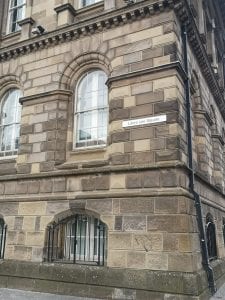
Prior to the event, SWAI and Reclaim the Night came together to temporarily re-name Queens Square ‘Laura Lee Square’ in honour of all our much loved and missed colleague, Laura Lee.”

#DecrimforSafety #SupportSafeSexWork

Today SWAI marks it’s 10 year anniversary and reflects over the work we have done and the work we need to do. 

Kate McGrew, current sex worker and director of the Sex Workers Alliance Ireland (SWAI) says “Since its inception in 2009 SWAI have sought to bring an alternative voice to the discussion around sex work. The dominant narrative then and now has conflated sex trafficking, human trafficking and human smuggling with consensual sex work. We give voice to the real experiences of currently working sex workers because we ARE currently working sex workers. This voice has been sorely lacking in Irish society.”

She continues “Since 2009 we have grown, taken on staff, have a majority sex working board and hired a sex worker as a director. This means that the lived experiences and voices of currently working sex workers permeate every aspect of our work. We have direct contact with hundreds of sex workers each year and we provide non-judgemental advice on many subjects such as housing and health, provided paths to justice and signposted services. We have helped workers gain refugee status and guided some through the justice system, resulting in a 20-year sentence for a serial rapist. 

Since 2009 this country has gone through a recession which we are slowly climbing out of, and it has undergone a sea-change in social change, with same-sex marriage, gender recognition and abortion access being legalised. 

Unfortunately, since 2009 client criminalisation has been introduced in Ireland which has a detrimental effect on the safety of workers here. It was brought in with great fanfare but none of the promises that were made has come to pass and in fact, we have seen a 92% increase in violent crime against us. Trust in the Gardaí amongst sex workers has fallen even further. This month alone we have seen a spate of attacks nationwide. We warned that this would happen but we were not listened to.

Sex workers want to work together for safety but the laws in 2017 changed to increase fines for so-called brothel-keeping and added a jail sentence. In June of this year, our worst fears were realised when two migrant workers, one of whom is pregnant, were sentenced to jail for the crime of working together for safety. The judge acknowledged that they were not coerced into this work and there were no bosses, pimps, traffickers or clients involved.

Since the law was introduced only a fraction of the arrests have been of clients. Sex workers bear both the legal brunt and the burden of navigating this law with clients who are potentially more dangerous and much more concerned for their own safety than that of the worker.

In the 10 years since SWAI has started our organisation has gone from strength to strength. We have succeeded in adding a different voice to the sex work discourse and given a voice to this hidden population. In the 2020 review of the law, we must be listened to as the experts in what is best for sex workers. 

To mark our 10 years we are re-launching our website https://sexworkersallianceireland.org/. Through it we provide easy to understand information about sex workers rights, support after sexual assault and budgeting and money management. It will also provide up to date news and our press releases. 

#DecrimforSafety #SupportSafeSexWork

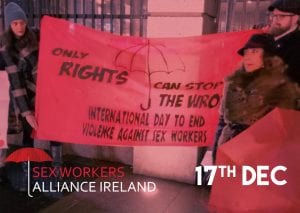
IDEVASW imageToday is International Day to Eliminate Violence Against Sex Workers. Safety and a life free from violence is everyone’s right. But sex workers are put in danger because of our laws and the stigma surrounding sex work. 

Catriona, current sex worker and chairperson of the Sex Workers Alliance Ireland (SWAI) said “Since the sex work laws changed in 2017 the lives, health and safety of sex workers have been put in danger. Here are the facts.

  1. Violence against sex workers increased by 92%
  2. Sex workers have less trust in the Gardaí than ever and less than 1% will contact the Gardaí if they are a victim of a crime
  3. Young migrant women bear the brunt of the so-called brothel-keeping laws, not pimps or traffickers
  4. Gardaí resources are being wasted on a failed experiment
  5.  When sex workers and Gardaí can work together justice can be done

She continues “Violence against sex workers has increased by 92% since 2017. Criminals know that sex workers are forced to work alone to work legally. This isolation makes them vulnerable to attacks. If workers work together for safety they are breaking the law. Criminals know this and attack them because they know the workers will not risk arrest by reporting. Sex workers make up 61% of trans people murdered this year globally. Some misguided people say that all sex work is a form of violence but what language do we use then to talk about the very real violence such as the spate of robberies that occurred in the past 6 weeks

We all expect laws and the Gardaí to keep us safe. But the current sex working laws and the way the Gardaí operate means that sex workers do not trust the Gardaí. The same Gardaí who arrest us for working together for safety are the ones we are expected to report to when there has been a crime committed against us. Gardaí are using the spate of crimes committed against sex workers lately as an excuse to clamp down on sex work. Is it any wonder trust is at an all-time low!

This year we have received data from a number of sources, including the Minister for Justice that the people who are arrested under the so-called brothel-keeping laws in Ireland are migrant workers) Not traffickers, not pimps but the women who the laws were purported to keep safe. 100% of the workers we speak to want to work together for safety. The law is failing and is being applied in a racist way. The Irish Human Rights and Equality Network report to the International Convention on the Elimination of All Forms of Racial Discrimination drew attention to this fact

Recent news has shown that some areas of the country cannot afford to take on new cases and cannot afford foot patrols. Garda resources are being squandered in an effort to police consensual sexual activity between adults. The laws have not reduced trafficking or indeed sex work. 

Sex workers want to work with the Gardaí to make Ireland a safer place. This year a serial rapist was sentenced to 20 years for a spate of attack on sex workers. SWAI was the first point of contact for the victims and the collaboration with Gardaí took a dangerous criminal off the street. Think of what we could accomplish if the laws worked with sex workers, not against them.

This International Day to Eliminate Violence Against Sex Workers, let’s fight for everyone, even if they do a job you are not comfortable with. Fighting for the safety and health of women includes sex workers who cannot or will not give up sex work. We need to acknowledge that it is a job, often people’s last resort, do not take it away from them. The End Demand model does nothing to address the real needs of sex workers.

We need to decriminalise sex work so that sex workers can be safe in our jobs. I want to be proud to be in this country where we take care of everyone and where the laws really keep us safe!

This is the last International Day to Eliminate Violence Against Sex Workers before the review in 2020. We are concerned that the voices of currently working sex workers will be ignored in the review. Sex workers voices are invisible in Ireland. We in SWAI are not speaking over or for sex workers we ARE sex workers, and we need to be heard in the review of policies that affect our lives. We deserve to be listened to.”

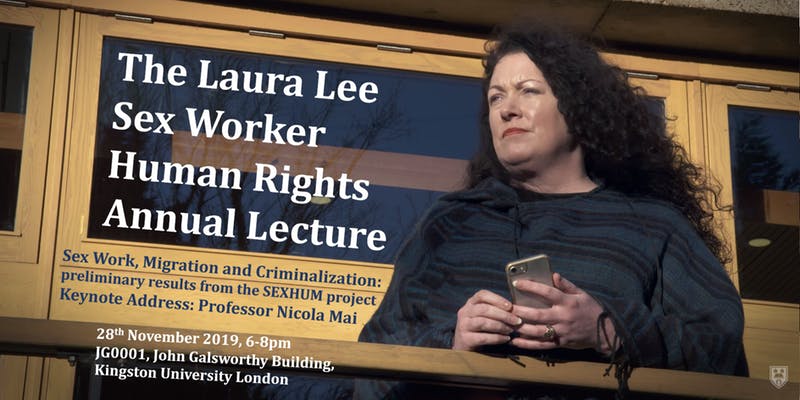
Laura Lee lecture image


In November 2019 we spoke at the 2nd Annual Laura Lee lecture. We read out a speech by a male sex worker. Male sex workers are absent from the conversation about sex work in Ireland. His speech highlights the stigma and shame that exists around sex work. We have helped this man get refugee status and he is now pursuing a career in journalism. Below is the transcript.

I was asked by Sex Workers Alliance Ireland (SWAI) to participate in today’s event, but because of stigma and as I’m exiting migrant sex worker I’ve declined. So, I’ve decided to write some paragraphs to tell my story.
I’m Nando (of course, not my real name) and I’m originally from Venezuela. For about seven years I was a prostitute in the emerald island, because I didn’t have good luck finding a job and the choices were selling my body or drugs.
Back in my country I was a working professional and not even thought of having a sugar daddy during my years in college to get my degree in Journalism.
But when you’re abroad things change, drastically. I’m a gay male average built, dark-skinned fella with long black hair.
By that time, when I arrived in Dublin, I was 26 years old and I thought my look made me exotic for gays, or bi curious straight Irish guys.
So, since I didn’t have any luck finding a job, I decided to be a full-time escort. I have good and bad memories, but I clearly remember when in March 2017, the Criminal Law (Sexual Offences) Act 2017 was commenced into force.
While it has been an offence to buy sex in Ireland, I started to meet fewer clients little by little. I had to reduce to my rates and engage into chemsex to get punters, which I didn’t want to, because when you’re high, sometimes, clients take advantage of you.
I still remember there were hard years, just keeping my head above water. I tried a marriage of convenience and it didn’t work out. I just wasted about 10 thousand euros.
When I was totally undocumented and with my passport about to expire in few months, I looked for help and I was told by experts in immigration and even an NGO that because I was sex worker, I wouldn’t get any papers.
The only good thing, this NGO did was to put me in contact with SWAI. They contacted solicitor Wendy Lyon and she agreed to meet me for a consultation.
Wendy told me it was my right to claim asylum given the circumstances in Venezuela and it wouldn’t care I was an escort.
I was lucky enough to avoid staying in Direct Provision and I must say my case was sorted out in over a year.
After almost four hours interview, in August 2018, with an immigration officer from the International Protection Office in Dublin, unexpectedly I got letter in the first weeks of October of 2018, saying that I should get declaration as a refugee.
Being honest, the immigration officer never asked me how I survived during eight years in Dublin. I think it was good luck.
By the end of October 2018, I got my declaration as recognised refugee in the Republic of Ireland and that was just the beginning of another battle.
So, as I wasn’t getting enough money from sex work since 2017 and I got my papers back last year, I thought I would ask for my social welfare benefits, given they must treat me as any Irish citizen.
I remember the first time approached the Department of Social Protection they asked three times why I didn’t have a passport. I had to explain them it’s the first thing an immigration officer take from you when you claim asylum and showed my ministerial letter.
Last July as I’ve been getting my social welfare allowance, I decided I didn’t want to be an escort anymore, because not even my regular clients were visiting me and because for me there’s no more profits from sex work. It was all the time about money, even though I enjoyed meeting few guys for cash.
Nowadays, I’m happy retraining as Journalist in Dublin, getting the digital skills, and because I got my degree in my native Spanish language 10 years ago, but there are days when I feel scared, you know that they could use my past against me.
I hope to make peace with my past any time soon and be able, in a couple of years, to stand up in front you and tell my story without shame.
And if anybody dare to judge me say or even shout: Bitch! I’m a journalist and I was undercover getting a better inside in the oldest profession.

With HIV diagnoses on the rise in Ireland as well as demands from clients empowered by a law that was supposed to help sex workers, workers now fear carrying condoms.

Kate McGrew, current sex worker and director of the Sex Workers Alliance Ireland (SWAI) said “Today is World AIDS Day. Ireland needs to wake up to the fact that there is an increase in HIV diagnoses each year here. 

We were assured that our sex work laws, which changed to client criminalisation in 2017, would make us safer. Instead, they have caused a 92% rise in violent crimes against, ensured the jailing of migrant sex workers and tipped the balance of power towards our clients.

We hear of clients who demand that condoms are not worn. We know that ‘stealthing’, the practice of removing a condom during sex without the knowledge of the sexual partner, is increasing. SWAI has recently supported a migrant sex worker who was too afraid to tell the nurse that she was an escort, and was thus refused PEP, for not being considered part of a high-risk group. Sex workers are afraid to carry condoms now in case they are used as evidence that the purchase of sex work has occurred. All of this flies in the face of best practice of HIV prevention. 

We all deserve to have health and safety but laws which police sexual expression, including transactional sex between consenting adults, lead to already marginalised people being pushed further into the margins. When sex workers, who in Ireland are mostly migrants, cannot work together in safety they take greater risks, such as shorter negotiations or lack of use of condoms. Stigma and shame lead to sex workers not attending services such as rape crisis centres or seeking justice if they have been a victim of a crime.” 

In Ireland, we hear from workers that Gardai routinely take condoms as evidence of sex work as well as any money made, during a brothel raid, even when they do not make any arrests and only tell the women to move on. This leaves the workers with no money to travel and with no safe way to make money to do so. Sex workers and trans workers, in particular, are at high risk for HIV and any law that makes them less likely to practice safe sex or get tested has a detrimental effect on an already vulnerable population.

Misguided politicians have been led to believe that our laws save sex workers, but instead, they put them in harm’s way. SWAI is the only sex workers rights group in Ireland that puts sex workers at the centre of their policy. We join many other sex workers rights groups in calling for full decriminalisation of sex work, including clients so that workers can have healthy and safe lives free from stigma.”