SWAI Statement on Closing

We are heartbroken to announce that the Sex Workers Alliance Ireland (SWAI) is closing our doors after over 16 years, due to a lack of funding.

Since our foundation in 2009, we have brought an alternative voice to the dominant narrative about sex work in Ireland. A voice that has centred the wants and needs of sex workers in Ireland. A voice that does not speak over sex workers. A voice that will soon be lost. 

We are proud of the work we have done in the past 16 years. Our CEOs and board brought essential lived experience to the discussion around sex work, workers’ rights and the human rights of sex workers in Ireland. We have not evaded difficult discussions and thorny topics. Ireland is still a country mired in Catholic shame and sex workers bear the brunt of that. We have focused on a harm reduction approach to ensure the health and safety of sex workers has been prioritised. 

We want to reiterate that other organisations that work with and represent marginalised communities should be extremely worried about the closure of SWAI. Sex workers have always been the canaries in the coalmine. Sex workers exist at the intersection of women living in poverty, trans and LGBTQI+ people, single mothers, migrants, undocumented people, people in addiction, homeless people and those in insecure housing, disabled people and people with mental health issues. If you are an organisation that provides services for those people, it should concern you that SWAI cannot secure funding to remain open. 

This community deserves better than the laws, stigma and discrimination they face at the hands of the state, the Gardaí and some parts of civil society. We have not shied away from critiquing the systemic barriers sex workers face in Ireland. Our failing laws have increased violence against sex workers and we have been silenced time and again. 

We want to thank the many organisations and individuals who have helped us along the way. Too many to mention. We leave it to you to ensure that sex workers are not left behind in Ireland. 

Before we close at the end of 2025, we will be delivering several sex worker awareness training sessions, so if your organisation is interested in receiving our training please get in touch. We have also developed a “Sex Worker Awareness Toolkit” for distribution that we are happy to email to any organisation interested in order to enhance their knowledge on sex work and how to provide non-judgemental support to sex workers. 

On the 17th of December, which is International Day to End Violence Against Sex Workers, we will be hosting a Goodbye Party at 7pm in Connolly Books in Dublin, so please come along to say goodbye and celebrate our collective victories over the past years. 

We are sad to say goodbye to our Communications and Advocacy manager, Linda Kavanagh, who has been with SWAI for 7 years. 

During her time with SWAI, she has spoken up for sex workers’ rights by speaking to the media, commenting on news items, promoting attendance at our events, shaping the visual identity of SWAI, honing our messaging, and communicating with politicians and policymakers. She has been the face behind our social media posts, ensuring that the voices of sex workers are heard in Ireland. We will miss you, Linda and wish you all the best for the future <3

“When I started in SWAI in October 2018, it was on the back of the successful referendum to get abortion access in Ireland. Through my activism with the Abortion Rights Campaign, I learned the importance of bodily autonomy, of affected-led organising, of feminism and that criminalisation does nothing to support health and safety. I took this information into the work I have done with SWAI.  I’ve learned so much from the sex workers and allies I have interacted with. 

I am incredibly proud of my work with SWAI. I hope I have helped shape the conversation around sex work in Ireland. I am devastated to leave this organisation at such a crucial point. I will continue to advocate for the health and safety of sex workers by calling for sex work to be decriminalised in Ireland.”

Due to lack of funding, SWAI will close our doors at the end of 2025. 

Ruth Coppinger TD speaking at the Red Umbrella Film Festival

The bill was co-created by Red Umbrella Éireann, the Sex Workers Alliance Ireland and the Street Workers Collective. These organisations are made up of sex workers and activists who are drawing on lived experience and mountains of evidence to bring forward a piece of legislation to fully decriminalise sex work and introduce regulations that centre the safety of sex workers. 

Launching the bill yesterday at the Red Umbrella Film Festival, Ruth Coppinger said “Reducing demand was a key aim of the 2017 Sexual Offences Act — this incontrovertibly has not worked, as the Minister for Justice himself admitted after the review of the legislation was published. 

Crucially, violence against sex workers, either by clients or by members of the Gardaí, remains widespread and sex workers themselves have explained how the current legislation has been disempowering for them, making them therefore more vulnerable to this violence. 

Gender based violence and violence against queer people is rampant in every part of society. Any hint of further marginalisation or stigmatising of sex workers, of course, may worsen the type of violence they are vulnerable to experiencing.

I am very glad to support sex worker activists who have drafted a decriminalisation bill and are launching their campaign to build up support for the same. The bill has as its heart a desire to remove any means by which sex workers can be stigmatised, repressed or harassed by the state, or in any way criminalised. Anything less is discriminatory, and furthermore is exacerbating the intersection of sexism, racism, queerphobia and anti-working-class oppressions that so many sex workers’ lives are affected by.” Ruth Coppinger will be bringing the bill to the Dáil and is seeking the support of TDs and Senators to progress the bill. 

“The Nordic Model was introduced under the premise that it would keep sex workers safe. However, research has shown that since its introduction 8 years ago, violence against sex workers has increased by 92%,” says Red Umbrella Éireann.

They continue “This bill is a direct response to this policy failure. Corroborated by thorough research and consultations with sex workers, this legislation directly addresses the dangers sex workers face — from reducing the risk of being a target for predators to removing barriers to reporting exploitation.”

The Street Workers Collective added “The model of criminalisation that we currently have allows Gardaí to continue to surveil and harass sex workers under the guise of protecting us. This is really dangerous because our experience with Gardaí is a violent one – one in five street workers have been sexually abused by them. It’s crucial that we decriminalise sex work so that they don’t have the same power to target us”.

“Criminalisation also prevents sex workers who want to leave from being able to do so. Many sex workers are doing sex work because of poverty and the current law just adds more suffering on top of the hardship we already face. You cannot criminalise people out of poverty. This bill is focused on protecting sex workers in work and removing barriers for those who want to do something else rather than trapping people in a punitive system.”

Linda Kavanagh, spokesperson for the Sex Workers Alliance Ireland (SWAI) said “ Anyone who cares about violence against sex workers, violence against women, the rights of the LGBTQI+ community, migrants, undocumented people, people in poverty and insecure housing or homelessness, people in addiction and people with disabilities MUST support this bill. 

This bill removes criminal sanctions for sex workers working together or hiring people to help them in their work, such as security or a driver. It does NOT decriminalise violence against sex workers, rape, exploitation or trafficking. The current client criminalisation and brothel-keeping laws have failed and have actively made the lives of current sex workers worse. 

Since 2009, SWAI has campaigned for the decriminalisation of sex work. The bill pulls from existing decriminalisation laws in New Zealand/ Aotearoa, parts of Australia and Belgium. We are extremely proud to have co-created this bill and to have produced a piece of legislation that is evidence-based and reacts to the reality of sex workers’ lives in Ireland.”

New ground-breaking research by the Sex Workers Alliance Ireland reveals the precarity and marginalisation that migrant sex workers experience when trying to access housing. 

Almi Modjeska, coordinator of SWAI said “Voices of sex workers in Ireland are constantly omitted and excluded from conversations leading to laws and policies directly affecting them. This constant omission guided our approach to this research, which is why this report also includes sex workers’ recommendations for meaningful action that will improve the situation for migrant sex workers in Ireland.”

Linda Kavanagh, spokesperson for the Sex Workers Alliance Ireland (SWAI) said “Our research includes sex workers in all aspects of the report. The questions asked were devised with the input of active sex workers. Despite the dominant narrative framing all sex workers as victims of gender based violence, sex workers are knowledge creators and are best placed to speak about their reality. Sex workers conducted the interviews, data analysis and report writing. When we say ‘Nothing About Us, Without Us’, we mean it.”

Kavanagh continued “The discussion around sex work in Ireland focuses entirely on violence against sex workers by clients, and their right to exit. The structural violence and discrimination they face from the state, the Gardaí, the housing crisis and by landlords is never mentioned. These are all issues that the government and all of us can address. Instead, all they are offered is the criminalisation of their income through laws that they were never meaningfully consulted on.” 

“Housing and migration are hot-button topics here. Ireland is one of eight countries that introduced the Nordic client criminalisation model. The country is currently enduring a housing crisis, with a severe shortage of housing options. The cost-of-living crisis, which has grown from the housing crisis, makes accessing decent work difficult. We know that more people are turning to sex work in Ireland to make ends meet. Ireland criminalises clients and has broad and harsh brothel-keeping laws that prevent sex workers from working together for safety. These laws make sex work less safe and drive sex workers away from paths to justice and services that can help them.”

Molly*, our interviewer, said “As a sex worker myself and someone who has experienced homelessness and precarious housing, I felt the participants really opened up to me in a way they wouldn’t to others. It makes a huge difference to be able to be spoken to on the same level, rather than to an academic who can’t fully understand our situation”

About being interviewed by a peer researcher, Stella* said “There is a level of trust there when you know that the person who interviews you has had similar experiences and can relate to you. It is not some expert or academic who does this research to enhance their academic or professional career, but people who are affected by the same issues you are, so you know they are interviewing you because they care and want things to get better for our community.”

The research was conducted in 2023 and 2024 and aims to understand personal experiences and perspectives of migrant sex workers, focusing on the intersection of housing and sex work. Understanding the housing experiences of migrant sex workers in Ireland is important as it is key to the betterment of their wellbeing, and it unveils broader societal issues.

The issues include

  • a national housing crisis
  • historical anti-sex worker prejudice in the Irish government
  • society and policing
  • racism
  • discrimination, anti-migration sentiment.

Key themes of the research include:

  • difficulties in finding suitable accommodation
  • substance use
  • entry into sex work
  • experiences of discrimination and predatory behaviour by landlords and property management companies

Key takeaways

  • Three-quarters of participants started sex work due to financial reasons
  • Brothel-keeping laws prevent sex workers from protecting themselves against predatory management
  • Three-quarters of participants rented private accommodation, while 25% were homeless or lived in hostels
  • 2 of the 8 are homeless, living in a hostel. Of those privately renting, 33% avail of HAP
  • The majority of participants lived in their current housing for 1 and 2 years
  • Several participants in this study have experienced eviction and some level of homelessness.
  • Several participants related experiences of discrimination when seeking or applying for housing

Calls to Action

  • Decriminalise sex work
  • Abolish brothel-keeping laws
  • Increase affordable housing
  • Strengthen tenant protection
  • Destigmatise sex work
  • Develop supporting housing programs

* Names changed to protect anonymity

This project was funded by ESWA (European Sex Workers’ Rights Alliance as part of activities related to the ESWA programme: ‘Decent (Sex) Work and Safer Housing – multi-stakeholder dialogues on inclusion and integration of migrant sex workers in Europe’.

The Sex Workers Alliance Ireland (SWAI) is in immediate danger of closing due to lack of funding.

Sex Workers Alliance Logo
EGM Announcement & Statement on pending closure

On a dark blue gradient background. There is an illustration of yellow hands holding a heart with thorns around it.

SWAI is running on fumes at the moment. Thanks to your support and the generous donors to our crowdfund, we have been able to continue operating until now. However, we have not confirmed any sustainable core funding for the future, so we will be operating pared-back services for the remainder of 2025. As it stands, we will then close at the end of the year.

We have and will continue to apply for funding, but we do not hold out hope that we will secure any. The funding landscape has always been bleak for sex worker-led organisations such as ours, and the current political climate has only exacerbated this.

Our radical work that critiques the government, the Gardaí, the Nordic Model, including client criminalisation and brothel keeping laws, makes us difficult to fund. We would not be giving voice to the needs and wants of sex workers in Ireland if we toned these statements down. We cannot ethically fulfil our role if we make ourselves more palatable to those in power. 

There are costs associated with running a not-for-profit, even if we are not taking in money and we cannot guarantee that we can cover them in the future. We also need to offer clarity to our two part-time paid staff. We are not taking this decision lightly.

We will hold an online EGM on August 12th, 2025, at 6:30 p.m., to dissolve the company. Please email info@swai.eu for the link. 

With the announcement of the closure of Ugly Mugs next month, it should greatly worry wider society that organisations that support the safety and wellbeing of marginalised communities cannot continue to operate in Ireland. We are a rich, diverse nation that prides itself on the progressive strides we have made in the past few years. The hypocrisy of the state and supporters of laws that put people in danger is sickening. These are shameful outcomes. 

We urge any organisation that is interested in taking our Sex Workers Awareness Training to book it as soon as possible because it will not be available in 2026. Please email outreach@swai.eu for more information or to book. 

Thank you to all our supporters who have stood by us, helped uplift our voices and given us support throughout the years. You can continue to donate to our crowdfund here: https://28-days-for-swai.causevox.com/. This will help us with our continuing running costs and pay our staff for as long as possible.

And to the sex workers in Ireland, who remain some of the strongest and most inspiring people we know. Sex workers have always taken care of each other, because they often had no one else to rely on. We don’t doubt that that will remain true. 

Actually listen to sex workers written in marker on canvas

“The review of the law governing sex work in Ireland is not worth the paper it’s written on”, says Linda Kavanagh, spokesperson of the Sex Workers Alliance Ireland. 

Part 4 of the Criminal Law (Sexual Offences) 2017 was due to be reviewed in 2020 but due to myriad delays, it was not released until yesterday. Linda Kavanagh continued “From the start, this review has been conducted in the most unethical and frustrating way possible. 

The terms of reference for this review state that the review will assess “the impact of the operation of that section on the safety and well-being of persons who engage in sexual activity for payment.” There is no evidence that active sex workers support this law in this report. No weight has been given to the voices of currently active sex workers in this review and there is scant evidence that sex workers were properly engaged in this process. The onus is on the Department of Justice to do this and SWAI raised this concern during forum discussions. 

From the initial survey to this final report, the review has taken the stance that the law is in and of itself a positive thing. SWAI fundamentally disagrees with this position and is supported by extensive evidence that sex workers are harmed by these laws. 

“There is no way to police the purchase of sex without surveilling sex workers. This review supports wasting Garda resources and increasing surveillance powers. Is the Department of Justice going to ignore how Gardaí have abused their powers? Where is the Department of Justice commissioned ‘I Must Be Some Person: Accounts from

Street Sex Workers in Ireland’ report? 

Minister O’Callaghan has admitted that demand for the purchase of sex hasn’t been reduced, so we ask, how can this report say that the law has made progress towards its objectives? Our concerns about the brothel-keeping laws, echoed by the sex workers who were spoken to, were dismissed because “the official statistics identify a shift away from the targeting of the seller to the purchaser”. Only 15 people have been prosecuted for purchasing sex! This also overlooks the fact that brothel-keeping raids and welfare checks to disrupt sex workers don’t end in convictions, but the consequences for sex workers are severe. Gardaí are still targeting sex workers in this way.

Where is the evidence that the law has reduced trafficking? Where is the proof that the law has removed barriers to sex workers accessing social infrastructure or paths to justice? Does it show that sex workers now increasingly report to the Gardaí when they want to report abuse? Does it show that violence against sex workers has decreased under the law? The answer to all of this is NO! 

For seven years we have listed how the law has affected the safety of sex workers. Condoms are used as evidence that sex work has occurred, flying in the face of HIV prevention plans and highlighting the hypocrisy of the government. Sex workers are forced to work alone to work legally, which is not something any other worker is forced to do. 

Government policy leads people into sex work and then it ensures sex workers are less safe. Instead of offering sex workers criminalisation of their income and non-existent resources like the “two dedicated phone lines for direct contact with An Garda Síochána on a 24-hour basis” sex workers should be listened to about the reality of living and working under the law. Where are the calls for resourcing sex workers to learn about their rights?  

State bodies have taken a cowardly approach to sex work. Sex workers were written out of policies and strategy documents. Sex work is framed as gender-based violence instead of an economic activity, which ignores the autonomy of sex workers, removes their labour rights and neglects male workers altogether. Sex worker-led organisations are denied funding. This myopic approach creates a feedback loop that means that the state is praised for actions by organisations that do not engage with sex workers in meaningful ways. 

The law has failed on its own terms, that much is clear. What isn’t clear is how the government and the Department of Justice can continue to ignore the health and safety of a population that it recognises as vulnerable. 

28 Days for SWAI Donate to the '28 Days for SWAI' Fundraising Challenge

We’re going to say it to you straight. We want to be transparent. SWAI is going to run out of money by April of this year. 

Despite great efforts, SWAI has no secured or expected income to fund our core work due to being viewed as too radical for publicly critiquing the Nordic Model, government, and policing. We reject the conflation of sex work with human trafficking and gender-based violence by so-called feminist organisations and refuse to uphold these injustices against sex workers.

Funding for sex worker-led organising is incredibly hard to find and we experience a very hostile funding climate in Ireland due to sex work being criminalised and conflated with human trafficking, both in public opinion and in legislation implementing the Nordic model since 2017. There are very few organisations willing to fund our work. We need your support.

We’re asking our allies to do the 28 Days for SWAI challenge, a fundraiser for SWAI that will take place in February. As a team, we are aiming to raise €10,000 altogether to fund SWAI’s vital work. 

We have been fighting hard to raise the voice of sex workers, and recent work includes the first edition of our sex worker-created Zine, the establishment of the SWAI Allies Network, funding from ESWA to research the housing needs of sex workers, meeting with other sex worker organisations and a politician in Westminster, rollout of our hugely successful Sex Worker Awareness Training superseding our target, numerous media interviews and press releases, and an incredibly successful creative event in collaboration with A4 Sounds in Dublin in 2023. 

It is vital that sex workers have a voice in Ireland. Recent research has shown how harshly sex workers feel stigma in Ireland. In recent years sex workers have been murdered, stalked, harassed and assaulted. SWAI is still the first point of call for sex workers who have been evicted, who have experienced violence at the hands of clients or the Gardaí, who have been turned away from sexual violence, domestic violence and mental health organisations and sex workers who need signposting to other services. Sex workers return to us again and again because we are judgement-free and meet them where they are at. Our focus in the past few years has been to work with well-funded organisations so that they provide stigma-free services.

We are worried that the review of the law regarding sex work will be pushed out until we run out of money, and we will be unable to coordinate a response. We are concerned that without support for SWAI, the voices of sex workers will disappear in Ireland. There will be no alternative voice in Ireland expressing the wants and needs of sex workers. 

If you are interested in participating in our 28 Days for SWAI challenge please let us know and we can send you the information. Alternatively, you can donate to the crowdfund directly. We plan to launch some merch in the near future. 

We rely on you, our supporters, to ensure our work continues. Can you help?

International Day to End Violence Against Sex Workers (17th Dec) exposes how laws that claim to protect are, in reality, resulting in harassment, violence and even death. The structural violence and stigma that sex workers face in Ireland are a result of a whorephobic* state that ignores sex workers’ needs in favour of laws based on ideology rather than safety.

No Shame no stigma, no stigma, cop on & talk about it Written in black marker on canvas

“The past 12 months have been oppressive for sex workers in Ireland,” says Linda Kavanagh, spokesperson for the Sex Workers Alliance Ireland (SWAI). “In January we reported scam texts targetting migrant sex workers that escalated to extreme threats of violence and death. Later in the year, we described the stalking and harassment by self-appointed monitors of sex workers, who compiled dossiers of information about sex workers and sent it to media, Gardaí and local politicians. We welcomed the Gardaí’s statement that these actions were concerning and that they endangered sex workers.” 

“However this year, the police have been failing sex workers. We received no contact when a predator stalked streets, who had previous convictions and was suspected of attempting to abduct and rape sex workers. A PSNI officer was accused of paying for sex and the PSNI admitted a woman being prosecuted for trafficking in Northern Ireland could credibly be a trafficking victim.

This year we learned that the Department of Justice is finalising the review into sex work laws in Ireland. This is deeply unethical and showcases the outgoing government’s contempt for sex workers. The review has been repeatedly delayed and the newest date that has been reported is early 2025. This process has been farcical. 

SWAI demands the release of this review as soon as possible because we know these laws are failing. The law did nothing to stop a brutal rapist who was jailed for 18 years in July of this year. In fact, statistics published by the courts and the Minister for Justice in October are proof that sex work laws are a complete failure. Again, we ask, who are these laws for?

“There has been a lot of discussion about violence against women on this island this year. We finally got confirmation that Paiche Onyemaechi who was killed in 2004, was a sex worker. Her case shows that even when a woman is murdered there is shame about outing her sex worker status. New research published this year shows that any aspect of the criminalisation of sex work harms sex workers themselves. This research also highlights that sex workers in Ireland have been ignored about the harms of the law and that, among the countries participating, sex workers in Ireland felt more stigmatised than in other countries.”

One sex worker has said “We are everywhere including in your workspaces. We’re nurses, teachers, paramedics, and the parents at the school gate. Take off the Hollywood lens about what you think sex workers are.” 

Kavanagh continued “We demand the new government, in whatever form it takes, recognises the violence it perpetrates against sex workers in Ireland. Whether it be through using condoms as evidence that sex work has occurred, the housing and cost of living crises that push people into sex work or the stigmatisation and silencing of a marginalised community, the state is a vector of violence. We need Ireland to get real about sex work.”

* Whorephobia is a term used to describe hate speech and overt discrimination against sex workers. It intersects with racism, xenophobia, classism, and transphobia, which often leads to structural discrimination, violence, and abuse. Whorephobia is deeply ingrained within societies…. – NSWP definition of whorephobia

Press release in speech bubble

Reports that the review of the law governing sex work in Ireland has been postponed until 2025 is a significant failure of accountability and transparency.

The Sex Workers Alliance Ireland (SWAI) condemns the Minister for Justice’s continued delays in releasing the promised review of the Nordic Model of sex work laws. The long-awaited review was expected to come out in the next few weeks, as we learned from the media in September. However, it will now be published in early 2025. This delay conveniently extends beyond the tenure of the current government. 

“How can we believe the Minister for Justice about anything when we are continually lied to about the date of this report?” says Linda Kavanagh, spokesperson for SWAI. “We learned this news through the media, which has been a feature of this farcical process over the past 4 years.”

“This review will be 5 years delayed come 2025. The can has been kicked down the road because there is a lack of political support, unlike other laws that have experienced strong public backing, such as the abortion law. However, this does not mean that health, safety, bodily autonomy, and lives are not at risk, just as they are at risk without access to abortion. Will the new government formed after November 29th ignore marginalised communities as much as the current one has?”

“The Department of Justice assured The Journal that sex workers were engaged in this process. We await evidence of this claim because when we engaged with the former independent reviewer, who has since stepped back, we were informed that there was not enough time to consult more sex workers. That was in 2022.” 

“Delaying the review while the laws continue to harm and kill is unconscionable and further compounds the damage caused by a deeply flawed legal framework. The Nordic Model has devastated the safety and wellbeing of sex workers in Ireland. Sex workers in Ireland face a rising tide of violence, evictions, and isolation due to the Nordic Model’s criminalisation of clients and punitive brothel-keeping laws. The tragic murder of sex worker Geila Ibram in 2023 highlights the direct consequences of a system that pushes sex work underground. Current laws prioritise ideology over evidence.”

Brothel-keeping laws criminalise shared workspaces, leaving sex workers vulnerable to eviction, exploitation, and homelessness. Criminalisation isolates sex workers, limits access to peer support, and erodes trust in Gardaí, with only 1% of sex workers reporting crimes compared to 81% of the general population.”

Research consistently demonstrates that decriminalisation is essential for reducing violence and improving safety. Meanwhile, the Nordic Model forces workers to prioritise client safety over their own, exacerbating risks and undermining their autonomy.”

“International Day to End Violence Against Sex Workers is less than a month away. Tomorrow is International Day for the Elimination of Violence Against Women. The 16 Days of Activism against Gender-Based Violence starts next week. The Irish government’s inaction and contempt for sex workers’ lives is a disgrace—we will not stand by while their harmful laws continue to maim, silence, and kill.”

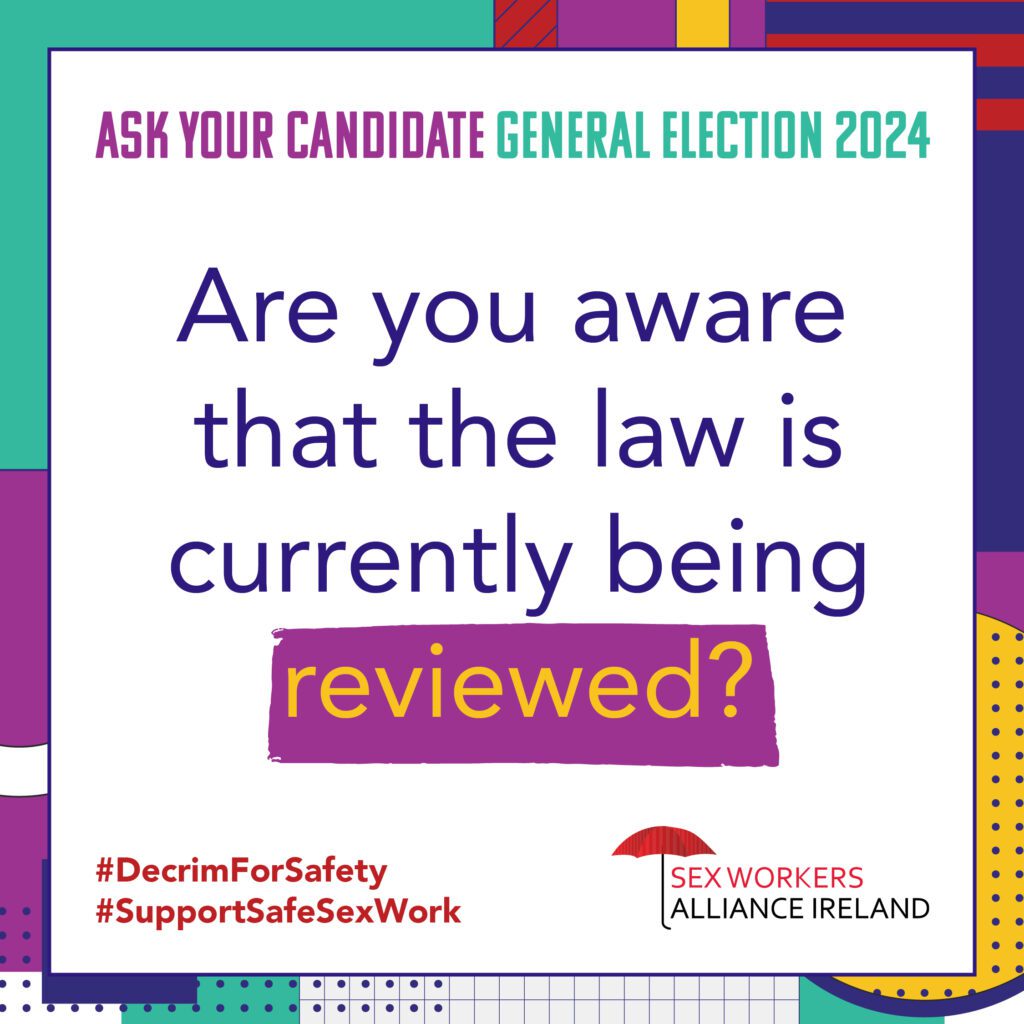
Are you aware that the law is currently being reviewed?

This review has been postponed until 2025 and is a significant failure of accountability and transparency. It will now be delivered 5 years late if this new date is to be believed.

Active sex workers are the most important voices needed in this review. It is of vital importance for sex workers’ voices in shaping policies that impact their lives.

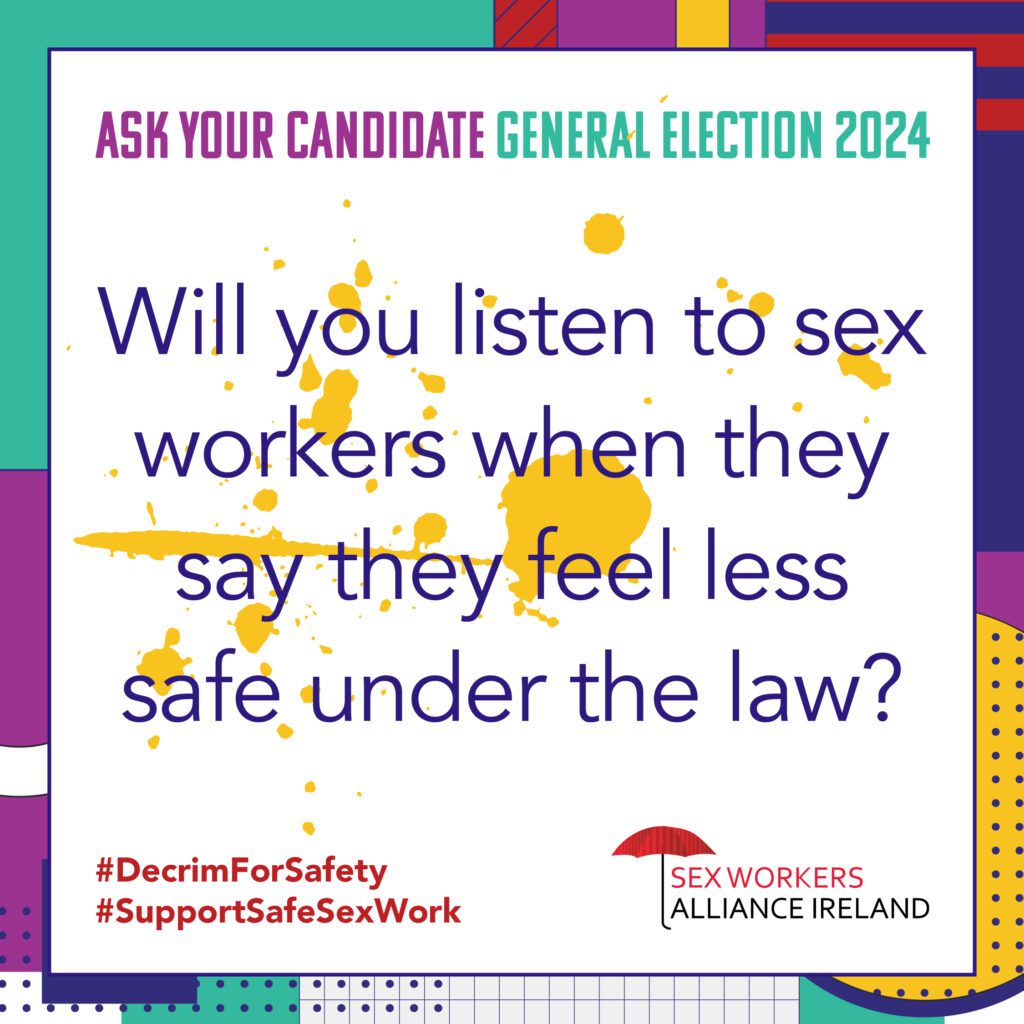
Will you commit to listening to sex workers or will you ignore marginalised communities as much as the current government has?


Where any aspect of sex work is criminalised, including client criminalisation it has adverse health outcomes for the workers.

Recent research has shown that sex workers in Ireland feel stigma more profoundly than their counterparts in Scotland and New Zealand.

Sex workers in Ireland face a rising tide of violence, evictions, and isolation due to the Nordic Model’s criminalisation of clients and punitive brothel-keeping laws. Will you listen to sex workers when they say they need decriminalisation?


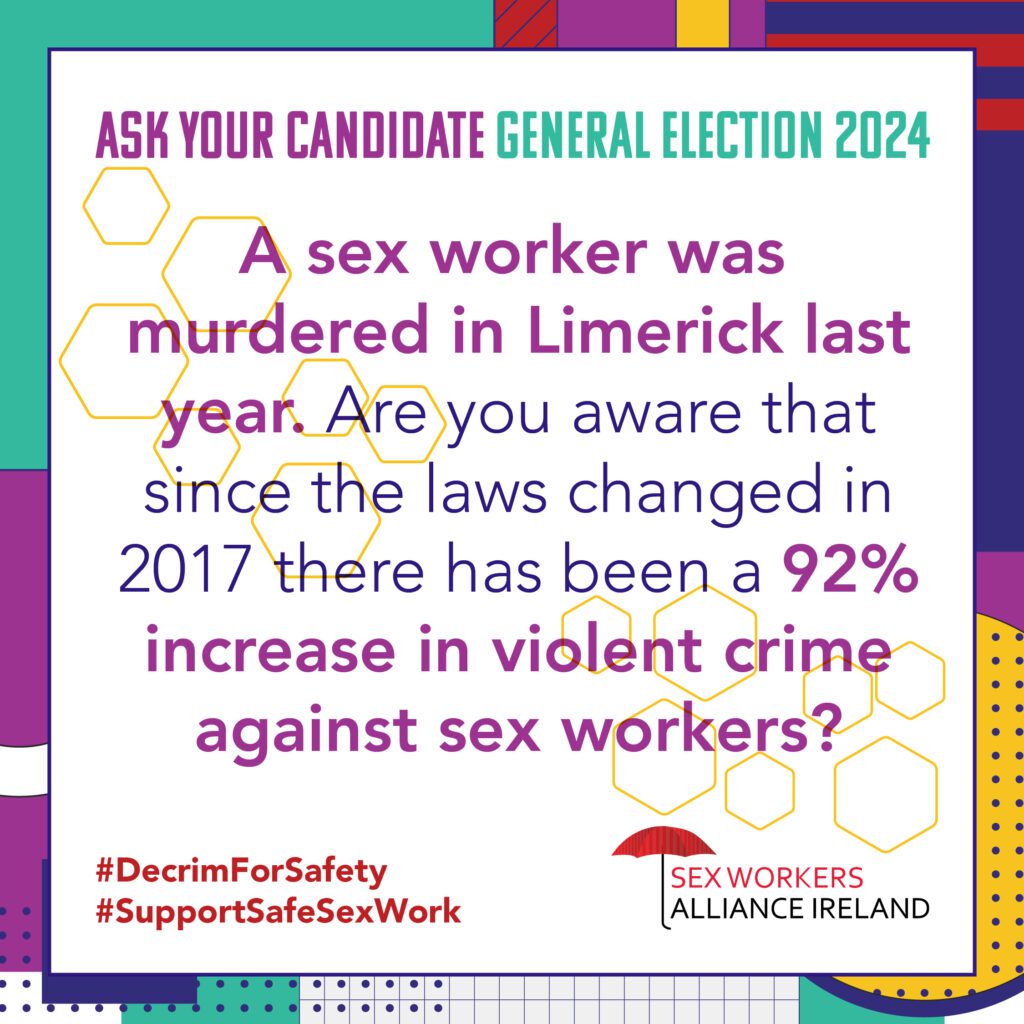
A sex worker was murdered in Limerick last year. Are you aware that since the laws
changed in 2017 there has been a 92% increase in violent crime against sex workers?

Sex workers are extremely unlikely to report an attack because of stigma and huge mistrust of the Gardaí. This has only gotten worse since the introduction of client criminalisation. Less than 1% of sex workers report crimes against them to Gardai, compared to 81% of the general population.

Criminalisation isolates sex workers, limits access to peer support, and increases stigma. Sex workers continue to operate in a climate of fear, where they are vulnerable to violence and exploitation, precisely because of the law.


Recently released court statistics show that there have been only a handful of prosecutions of clients.

Meanwhile, sex workers in Ireland have faced increased violence, threats, murder and stigma.

Any form of criminalisation of sex work harms sex workers. This focus on punishing clients has done nothing to improve the situation for sex workers and has actively made things worse. Our laws drive the industry further underground, making it more dangerous for sex workers.

The law has created a hostile environment where clients and sex workers themselves are deterred from reporting violence or exploitation for fear of prosecution, leaving sex workers more isolated and at risk.


Are you aware that almost all of the people who have been prosecuted under our brothel-keeping laws are young, migrant women?

You don’t have to take our word for it; the Irish Human Rights and Equality Commission report on Ireland’s compliance with the UN Convention on the Elimination of All Forms of Racial Discrimination (CERD) highlights that brothel-keeping laws are being applied in a racist way.

The law targets young migrant women, not pimps or traffickers.

Two sex workers were given a jail sentence in 2019 for the crime of working together for safety, one of whom was pregnant. Others have been fined, deported and left with a criminal record.


Did you know that when sex workers work together for safety, 
it is considered illegal under the law?

Sex workers are forced to work alone to work legally, which is not something any other worker is forced to do.

Criminals are targeting sex workers precisely because they are forced to work alone or risk breaking the law.  Alternatively, they target those working together for safety because those in so-called brothels are less likely to call the police. 

Most sex workers we speak to want to work with another worker. Working alone is enforcing the isolation that sex workers already feel. Shame and stigma mean that sex workers feel disenfranchised


Next Friday we will vote for the next government of Ireland. We are asking you, as sex workers and allies, to talk to the future leaders of the country about the rights of sex workers.

We’ve made it easy and put together this handy, printable PDF that you can stick on the back of your door to remind you.

We know many pressing issues in Ireland need change. Sex workers are affected by the lack of secure housing, rising rents, the cost of living crisis, lack of affordable childcare, an underfunded health system that doesn’t work for them and inadequate mental health services.

We’re trying to change the conversation around sex work in Ireland and we need your help!