1. What do you think about our sex work laws? 
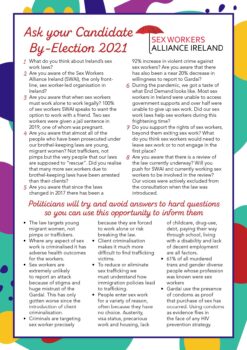
  2. Are you aware of the Sex Workers Alliance Ireland (SWAI), the only front-line, sex worker-led organisation in Ireland?
  3. Are you aware that when sex workers must work alone to work legally? 100% of sex workers SWAI speaks to want the option to work with a friend. Two sex workers were given a jail sentence in 2019, one of whom was pregnant. 
  4. Are you aware that almost all of the people who have been prosecuted under our brothel-keeping laws are young, migrant women? Not traffickers, not pimps but the very people that our laws are supposed to “rescue”. Did you realise that many more sex workers due to brothel-keeping laws have been arrested than their clients?   
  5. Are you aware that since the laws changed in 2017 there has been a 92% increase in violent crime against sex workers? Are you aware that there has also been a near 20% decrease in willingness to report to Gardai? 
  6. During the pandemic, we got a taste of what End Demand looks like. Most sex workers in Ireland were unable to access government supports and over half were unable to give up sex work. Did our sex work laws help sex workers during this frightening time?
  7. Do you support the rights of sex workers, beyond them exiting sex work? What do you think sex workers would need to leave sex work or to not engage in the first place? 
  8. Are you aware that there is a review of the law currently underway? Will you push for SWAI and currently working sex workers to be involved in the review? Our voices were actively excluded from the consultation when the law was introduced.


Politicians will try and avoid answers to hard questions so you can use this opportunity to inform them

We have made a handy printable guide so you can stick this on your door and be ready for whenever politicians call to your home looking for a vote. 

For the second year in a row Ireland languishes in the Tier 2 Watchlist of the Trafficking in Persons report. Ireland has still not persecuted anyone for trafficking in 7 years and this year marks the fewest trafficking victims identified since 2013. 
Aoife Bloom, sex worker and spokesperson for the Sex Workers Alliance Ireland (SWAI) says “This report highlights how the Nordic Model of client criminalisation has failed. The law was brought in with great fanfare as it sought to end the exploitation of people in the sex industry by ending demand. Since then victim identification has fallen and anecdotally we know that Garda intelligence on trafficking for the purposes of sexual exploitation has decreased since the introduction of this law. Violence against sex workers has also increased by 92% in that time. 

“The Trafficking in Persons report and experts acknowledge that Direct Provision is unsuitable accommodation for trafficking victims, which is a tacit acknowledgement that Direct Provision can compound trauma and is not fit for purpose. We support the Movement for Asylum Seekers (MASI) and other organisations’ calls to End Direct Provision.

“We welcomed the news earlier this year on the introduction of the National Referral mechanism and we anticipate the inclusion of NGOs who do not conflate all sex work with sex trafficking. We also support the report’s call for an exemption for crimes committed while trafficked, as we know in Northern Ireland a woman was convicted of trafficking while being a victim of trafficking herself, and migrants have been prosecuted for working in cannabis grow houses while being labour trafficked.

“The government didn’t initiate any prosecutions for labour trafficking in 2020 but has spent significant money on ‘Awareness-raising’ schemes. The fishing industry has been highlighted as a site of exploitation by NGO’s working with migrants yet no trafficking victims were identified in 2020.”

“Sex workers have not been included as part of Ireland’s anti-trafficking forum. Sex workers and sex worker-led organisations need to be recognised as a vital part of anti-trafficking efforts. Unfortunately, Ireland’s anti-trafficking efforts intersect with our repressive laws which seek to prohibit all sex work. This conflation of sex work and sex trafficking makes sex workers more vulnerable to exploitation and violence by pushing their livelihood underground, it also diverts resources away from fighting trafficking and prolongs the suffering and exploitation of trafficking victims. In fact, these laws have focused almost exclusively on young migrant sex workers working together for safety.

“Sex workers can be an ally in anti-trafficking efforts but we are unutilised and over-policed, making more difficult for us to report exploitation. 

“Sex trafficking is a complex and abhorrent crime and the solutions to trafficking in Ireland lie in prevention. Oppressive border controls and lack of legal migration avenues, as well as poverty and addiction increase trafficking. SWAI also calls for a firewall between immigration and other parts of the justice system so that undocumented people who have been exploited, assaulted or raped do not fear deportation.

“Sex work must be recognised as work so that sex workers can enjoy the same labour rights as other workers. In other sectors, strong unions and proper reporting mechanisms have a role to play in ending exploitation. But as sex workers operate in a partially criminalised environment we cannot organise like other workers. Separating out sex trafficking from other forms of trafficking has created laws that make us more vulnerable. 

“SWAI continues our call to decriminalise sex work to ensure the health and safety of consensual sex workers and those exploited in the sex industry. The focus on clients and sex workers working together for safety does nothing to combat trafficking. Decriminalisation of sex work will not decriminalise trafficking but will allow sex workers to report exploitation without fear.”

Sex Workers Alliance Ireland (SWAI) has announced that its Director, Kate McGrew, is departing having worked with the organisation for a period of six years. During this period SWAI developed into a strong representative body for the rights of sex workers and it also developed as a  service provision organisation.

SWAI said that “Kate has played an invaluable role in building SWAI as a strong voice for sex worker rights advocacy in Ireland. Her work contributed to a  growing awareness among politicians and society of sex workers’ realities and needs. In particular, she worked to improve public understanding of issues related to stigma, marginalisation and the detrimental impact of Ireland’s current criminal laws on sex workers’ lives. Kate was also instrumental in securing an amendment to decriminalise outdoor workers in legislation proceeding through the Houses of the Oireachtas. Her commitment to the development of SWAI and her contribution in progressing human rights and respect for all sex workers in Ireland will always be highly valued and we wish her every success in the future.”


Kate McGrew said: “It has been a privilege to work alongside the members of SWAI for the past six years and I wish them well in their continued work and endeavours.

“Now, however, is the right time for me to concentrate on my artistic work in theatre and music, where I will continue to highlight the injustices suffered by sex workers through stigma and criminalisation, and the continual urgency for the state to acknowledge our needs, as well as our value and contributions to Irish society.”

Press release in speech bubble

Sex Workers Alliance Ireland (SWAI) Welcomes Minister McEntee’s Initiativeto Expunge 607 Convictions for the Sale of Sex but says it does not go far enough. 

The Criminal Law Sexual Offenses Act 2017 criminalised the purchase of sex and nearly tripled penalties for sex workers working in pairs or groups. In the late stages of the passing of the bill SWAI managed to succeed in getting decriminalisation of outdoor workers as an amendment, despite it not being the original intention of the law.

Kate McGrew, Director SWAI: “We can assume that the convictions that are being overturned are instead for outdoor workers, and not for workers sharing a workspace, as under this law they face tripled penalties, and potential jail time, We have seen workers serving sentences under this law since its inception in 2017. However outdoor workers are criminalised in a number of other ways, including under COVID regulations.

For sex workers who would like to move on to other work, a criminal record is a major obstacle in doing so. SWAI demands that criminal records for brothel-keeping also be expunged, as this is defined as criminalisation of merely co-working, and this is where the majority of sex worker convictions have occurred since 2017. This law continues to force us to work alone if we are to work legally.” 

SWAI advocates for full decriminalisation of the sex industry, including a reversal of client criminalisation, which criminalises our income and pushes us deeper into precarity,  in order to remove barriers to justice. Worldwide evidence has shown that this is the best legislative model for best outcomes for a marginalised and diverse population.”

Decrim for SAfetySex Workers Alliance Ireland (SWAI) demands that the courts obey the blanket ban on deportations reinstated by the Taoiseach since Level 5 Covid restrictions began.

A 32-year-old Polish native with an 11-month old son was handed down a suspended sentence yesterday in Waterford court for facilitating prostitution. She was given the choice of a 1 year prison sentence in Ireland or leaving the Republic within the next 14 days, with a promise to not return for 5 years. Her resultant departure from Ireland – whilst not officially a deportation – flies in the face of the health advice that led the Taoiseach to reinstate the deportation moratorium. 

The judge incorrectly stated that “the sale of sex is a crime”. He, however, acknowledged that no one involved had been coerced and that the sex work was an economic activity. Notably, there was mention of a man present whom it was believed the women in the apartment were “fearful” of, yet it was the new mother herself who was faced with any charge. The judge also mentioned that “Society has to be protected from this sort of behaviour” harkening back to an old Ireland where stigma and shame of sexuality subjugated women.

This is another case where the brunt of the so-called brothel-keeping laws are born by migrant sex workers, as highlighted by the brothel-keepers research. The brothel-keeping law means that even two workers working together for safety are working illegally which increases our precarity.

Kate McGrew, sex worker and director Sex Workers Alliance Ireland, stated: “We advocate for a decriminalised sex industry in order that sex workers can avail of safe and vetted work environments. It is due to the current criminalization, direct and by proxy, that sex workers are forced onto a black market where criminals are poised to take advantage of our lack of options.”

She continues: “Where we are concerned about the well-being of those in the sex industry, we must acknowledge that our ability to make safe decisions is curtailed by this criminal law.”

Press release in speech bubble

Liam Vickers preyed on a vulnerable trans woman and was enabled by our recently changed laws 

Kate McGrew, director of Sex Workers Alliance Ireland (SWAI) says “The Sex Workers Alliance Ireland (SWAI) applauds this brave sex worker who reported the crime and we call for an end to the criminalisation and stigmatisation that leaves this vulnerable population in the shadows.” 

She continues “This occurred immediately in the wake of increased criminalisation of both this worker and her client. The change in law created an environment wherein our vulnerability was highlighted in the media, without providing any new protections for us whatsoever. The law increased criminalisation of people co-working, under “brothel-keeping” legislation, distancing us from authorities, and also forcing us to work alone if we were trying to work within legal parameters. Since the law changed in 2017 we have seen a 92% increase in violent crimes against us. This is yet another example.

SWAI calls for full decriminalisation of the sex industry. Were Ireland to repeal the criminalisation of brothel-keeping and the purchase of sex, we would see more sex workers engaging with the justice system. We will see better outcomes for sex workers when we have legal and vetted options within the industry. We will see better outcomes for sex workers as society begins to acknowledge the reality that sex work is an economic activity, and therefore sex workers are labourers deserving of protections afforded to all workers. Irish culture is moving in this direction, it is time that this be reflected at state and policy levels.

In the 2017 incident, the escort was obviously the victim of a violent crime. Yet, in Vickers’ statement the court heard that he brought the knife that he used to stab the victim because it was he himself who was afraid of “being robbed”. Sex workers are forced to work alone by our laws, which increased penalties for so-called brothel-keeping in 2017.

Sex workers are perpetually bound by the dichotomy of victim and criminal identities. Depending on the moment, either will be deployed against us and used to erase our perspective of our own experiences.”

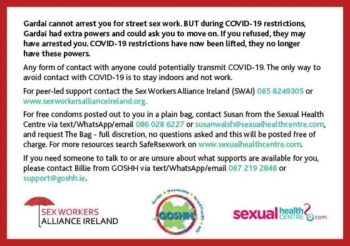
Back in July, the Sex Workers Alliance Ireland (SWAI) held a webinar to launch a new harm reduction resource we developed in collaboration with GOSHH in Limerick and Sexual Health Centre in Cork. The information card provides practical advice for anyone selling or trading sex on the street or outdoors during the pandemic and was created by a group which included current street workers, other sex workers and support workers with experience in this area.

When the pandemic started, harm reduction guidelines appeared online with advice for sex workers who continued in-person sex work out of necessity. Here in SWAI, our outreach worker Becky joined up with Billie, the support worker in GOSHH, as they realised that there was nothing available with specific information for people working on the street. More people joined the group and, in writing the guidelines, we focused on simple steps people could take to reduce the risk of COVID transmission, to protect themselves when selling sex. There is no way to guarantee safety when you’re in close contact but people still need to make money and these are just some tips for keeping yourself safer while working. The tips are also not just relevant for sex workers, they can be useful for anyone because, of course, people are still having sex even in a global pandemic! The information can be especially helpful for anyone meeting others for sex outdoors or in cars.

The leaflet is COVID-19 specific so all of the advice is focused on reducing the risk of contracting COVID but this needs to be taken into consideration alongside protecting yourself in terms of your overall health and physical safety. Sex workers are used to risk assessing and making judgements for their own safety, and often go by gut instinct. This new information isn’t supposed to override all of that and we always stress that your immediate physical safety takes priority.

On the back of the card we have included some facts about the law. We know from experience and discussions with other street workers that not everyone knows what the laws around sex work are, including the Gardaí! Since 2017, selling sex on the street is legal but paying for sex is not. It is also illegal to work indoors with other people but you are allowed to work inside alone. The Gardaí were given new powers at the start of the pandemic which allowed them to move on and even arrest people who were not complying with lockdown orders. These laws have now been rescinded but currently on-the-spot fines exist for people found breaking COVID regulations. However, you should not be getting in trouble or arrested for street working otherwise and if you are having any issues with this you can contact us for advice and support. 

SWAI is a sex-worker led organisation working towards giving a voice to people who are in sex work by choice, circumstance or coercion. We believe that sex workers know what is best for us and are best placed to advocate in the policies that affect our lives. We also work to provide support to any sex workers who need it whether they work indoor, outdoor, online or another section of the industry. We have peer support available so that you can speak to someone who has a similar experience, without any judgement. We can help with a range of issues including legal, immigration, accessing addiction or housing and homeless services, health, or if you want to look at leaving sex work and need support. 

If you want to contact us you can call Becky on: 085 824 9305 or email outreach@swai.eu

Here is a link to the resource and if you are interested in attending a webinar about this issue please get in contact with us Leaflet Print ready v2

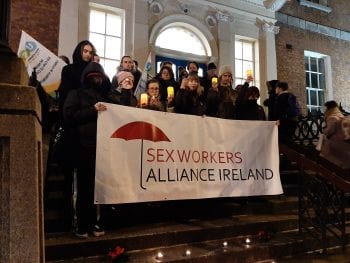
Images from vigil 2019December 17th marks International Day to End Violence Against Sex Workers.

Kate McGrew, director of Sex Workers Alliance Ireland (SWAI) says “This year the review of the sex work laws has begun and we worked to ensure that sex worker’s voices were heard in the policy decisions that govern our lives. These laws have kept us isolated by ensuring we work alone or forcing us to break the law when we work together with another worker for safety. Poverty is brutal and taking away our options does nothing to increase our safety. These laws have increased violence against us and only by fully decriminalising sex work will we begin to remedy that and centre the safety of sex workers.”

She continues “The End Demand laws were purported to end trafficking but Ireland has moved down to the Tier 2 Watchlist in the US Trafficking in Persons Report this year. 

This year so-called brothel workers remain imprisoned. In Limerick, co-workers were attacked precisely because they were working together for safety and they had no legal recourse that would not result in them also being arrested. We have seen more migrant workers sentenced around the country. Our sex work and so-called brothel-keeping laws continue to be applied in a racist way.

This year has been devastating for all marginalised people including sex workers. Because of the quasi-legal nature of our work, most sex workers did not qualify for PUP and were left behind. Our organisation was also refused funding and admission to government committees for vulnerable people because we recognise that sex work is an economic activity. 

Almost half of sex workers in Ireland were unable to give up work during the pandemic and even now most have returned to work. It is simply unfeasible to expect people not to work for 9 months of the year, even if your job is intimate work. Demand for sex work was severely reduced this year and yet there were little to no supports for sex workers. Laws that are based on ideology instead of worker safety are state-supported violence against us. 

Gardaí also used COVID laws to move on and detain workers and they continue to misrepresent the law. Street sex work is decriminalised in Ireland yet street workers have been pulled off the street and photographed in Garda stations so that the Gardaí can more easily identify them if they are murdered. They are then released back onto the street hours later with their whole night’s work ruined. This forces street workers to take on work they would normally turn down because the need for money is more important than the fear for their own safety. 

As we face into a recession we know more and more people will turn to sex work, as they did in 2008, to make ends meet. Our laws should ensure safety for these new workers, not put them in more danger as they have since 2017.

In the last few weeks, the sex worker community has been devasted by blow after blow. Scotland is currently consulting on introducing the Nordic Model and the UK passed its first reading on legislation to introduce End Demand laws there too. These laws are being introduced for moral reasons with no evidence that they work. Sex workers are being ignored again about the reality of lives and our safety. Sex workers continue to have their income curbed as various platforms such and Instagram and Facebook have banned us and many financial platforms such as Paypal, Visa and Mastercard do not allow us on them. During a global pandemic, we need to be able to access cash. SWAI struggled with this issue when giving our hardship funds. 

However, as always the sex work community takes care of our own because no one else will. We created a hardship fund which gave small grants to over 170 sex workers during the first lockdown. We also created a number of harm reduction guidelines for those who could not give up work. 

The Sex Workers Alliance Ireland also received our first Irish funding, a milestone for us and an acknowledgement that affected led advocacy is key. Despite the constant cruel stigma, laws that have made us less safe and a society that wishes we weren’t there we are resilient and we deserve to be heard.”

#DecrimforSafety #SupportSafeSexWork

Images from vigil 2019

Details are as follows:

Event: Candlelit vigil to mark International Day to Eliminate Violence Against Sex Workers

Date: Thursday 17th December

Location: Gates of Leinster House

Time: 6:30pm

Hosted by: Sex Workers Alliance Ireland

The Sex Worker Alliance Ireland (SWAI) will hold a candlelit vigil outside Leinster House at 6:30pm on Thursday 17th December to mark International Day to Eliminate Violence Against Sex Workers. This will be a small, socially distanced gathering.

This year the review of the sex work laws has begun and we worked to ensure that sex worker’s voices were heard in the policy decisions that govern our lives. These laws have increased violence against us and only by full decriminalisation of sex work will we begin to remedy that and centre the safety of sex workers.

Photographers/journalists are invited to attend.

For more information, please contact: linda@swai.eu

Facebook event: https://www.facebook.com/events/384174262793313

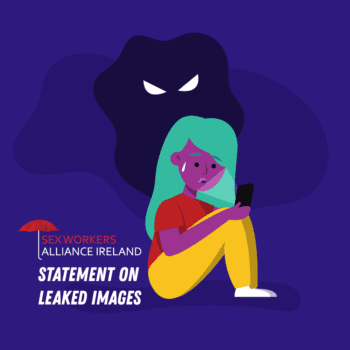
woman looking at phone with creepy ghost behind herConsent is vital for any sexual relationship, whether online or in-person, whether transactional or not. The leaking and distribution of sexual images which have been reported recently breaches the consent and trust of those involved.  

Misogyny, rape culture and consent are at the heart of this, issues sex workers are all too familiar with. We have seen an effort by people who wish to eradicate sex work to separate those whose Only Fans images have been leaked and those who have had their private images released by former partners but we expect everyone to stand together to oppose slut shaming and hatred of women’s sexuality in all its forms. Sex workers are constantly excluded from the consent conversation in Ireland but we are in the middle of this scandal. We are not outside of this, anyone who sells sexual services including nudes is doing sex work.

Sex workers have learned not to turn to the laws and Gardai to keep us safe. The criminal justice system fails sex workers every day. The sex work laws which were brought in with great fanfare were supposed to keep us safe but have led to a 92% increase in violence against us. Sex workers are now less likely to report to Gardai when they are victims of a crime than they were 3 years ago.

Sex worker’s images and stories are regularly taken without consent by media outlets and organisations who fight to end our means of survival without providing alternatives. We understand all too well how stigma and fear of being outed as a sex worker can affect you, and we know that being outed is many people’s worst fear. We know people have had the knowledge of their sexual services used against them in custody battles, housing and employment.

People have reached out to our organisation because they want sex worker-friendly, peer-led support. Earlier this year we were refused funding from the Department of Justice. We can only afford to pay our outreach staff for 1 day per week, we cannot run a 24-hour hotline. Lack of support from the top down in Ireland means that we cannot provide the support we want to but we will do our best to see that those who contact us are supported.

Ireland needs decent, non-stigmatising sex education, consent education and an overhaul of how women are viewed in society. We cannot rely on the criminal justice system alone to do this. Sex worker’s trust in Gardaí in Ireland is at an all-time low. Dara Quigley’s images were leaked by a Garda, in case you needed reminding. Marginalised people such as the undocumented cannot and will not turn to the very Gardaí who deport them for help. We cannot leave them behind. 

To that end we are having an online support meeting for anyone who sells images for money that has been affected by this incident online on Tuesday 1st December. Contact us at info@swai.eu or contact Becky at 085 824 9305.