Sex Workers Alliance Ireland (SWAI) has announced that its Director, Kate McGrew, is departing having worked with the organisation for a period of six years. During this period SWAI developed into a strong representative body for the rights of sex workers and it also developed as a  service provision organisation.

SWAI said that “Kate has played an invaluable role in building SWAI as a strong voice for sex worker rights advocacy in Ireland. Her work contributed to a  growing awareness among politicians and society of sex workers’ realities and needs. In particular, she worked to improve public understanding of issues related to stigma, marginalisation and the detrimental impact of Ireland’s current criminal laws on sex workers’ lives. Kate was also instrumental in securing an amendment to decriminalise outdoor workers in legislation proceeding through the Houses of the Oireachtas. Her commitment to the development of SWAI and her contribution in progressing human rights and respect for all sex workers in Ireland will always be highly valued and we wish her every success in the future.”


Kate McGrew said: “It has been a privilege to work alongside the members of SWAI for the past six years and I wish them well in their continued work and endeavours.

“Now, however, is the right time for me to concentrate on my artistic work in theatre and music, where I will continue to highlight the injustices suffered by sex workers through stigma and criminalisation, and the continual urgency for the state to acknowledge our needs, as well as our value and contributions to Irish society.”

Press release in speech bubble

Sex Workers Alliance Ireland (SWAI) Welcomes Minister McEntee’s Initiativeto Expunge 607 Convictions for the Sale of Sex but says it does not go far enough. 

The Criminal Law Sexual Offenses Act 2017 criminalised the purchase of sex and nearly tripled penalties for sex workers working in pairs or groups. In the late stages of the passing of the bill SWAI managed to succeed in getting decriminalisation of outdoor workers as an amendment, despite it not being the original intention of the law.

Kate McGrew, Director SWAI: “We can assume that the convictions that are being overturned are instead for outdoor workers, and not for workers sharing a workspace, as under this law they face tripled penalties, and potential jail time, We have seen workers serving sentences under this law since its inception in 2017. However outdoor workers are criminalised in a number of other ways, including under COVID regulations.

For sex workers who would like to move on to other work, a criminal record is a major obstacle in doing so. SWAI demands that criminal records for brothel-keeping also be expunged, as this is defined as criminalisation of merely co-working, and this is where the majority of sex worker convictions have occurred since 2017. This law continues to force us to work alone if we are to work legally.” 

SWAI advocates for full decriminalisation of the sex industry, including a reversal of client criminalisation, which criminalises our income and pushes us deeper into precarity,  in order to remove barriers to justice. Worldwide evidence has shown that this is the best legislative model for best outcomes for a marginalised and diverse population.”

Decrim for SAfetySex Workers Alliance Ireland (SWAI) demands that the courts obey the blanket ban on deportations reinstated by the Taoiseach since Level 5 Covid restrictions began.
A 32-year-old Polish native with an 11-month old son was handed down a suspended sentence yesterday in Waterford court for facilitating prostitution. She was given the choice of a 1 year prison sentence in Ireland or leaving the Republic within the next 14 days, with a promise to not return for 5 years. Her resultant departure from Ireland – whilst not officially a deportation – flies in the face of the health advice that led the Taoiseach to reinstate the deportation moratorium. 

The judge incorrectly stated that “the sale of sex is a crime”. He, however, acknowledged that no one involved had been coerced and that the sex work was an economic activity. Notably, there was mention of a man present whom it was believed the women in the apartment were “fearful” of, yet it was the new mother herself who was faced with any charge. The judge also mentioned that “Society has to be protected from this sort of behaviour” harkening back to an old Ireland where stigma and shame of sexuality subjugated women.

This is another case where the brunt of the so-called brothel-keeping laws are born by migrant sex workers, as highlighted by the brothel-keepers research. The brothel-keeping law means that even two workers working together for safety are working illegally which increases our precarity.

Kate McGrew, sex worker and director Sex Workers Alliance Ireland, stated: “We advocate for a decriminalised sex industry in order that sex workers can avail of safe and vetted work environments. It is due to the current criminalization, direct and by proxy, that sex workers are forced onto a black market where criminals are poised to take advantage of our lack of options.”

She continues: “Where we are concerned about the well-being of those in the sex industry, we must acknowledge that our ability to make safe decisions is curtailed by this criminal law.”

Press release in speech bubble

Liam Vickers preyed on a vulnerable trans woman and was enabled by our recently changed laws 

Kate McGrew, director of Sex Workers Alliance Ireland (SWAI) says “The Sex Workers Alliance Ireland (SWAI) applauds this brave sex worker who reported the crime and we call for an end to the criminalisation and stigmatisation that leaves this vulnerable population in the shadows.” 

She continues “This occurred immediately in the wake of increased criminalisation of both this worker and her client. The change in law created an environment wherein our vulnerability was highlighted in the media, without providing any new protections for us whatsoever. The law increased criminalisation of people co-working, under “brothel-keeping” legislation, distancing us from authorities, and also forcing us to work alone if we were trying to work within legal parameters. Since the law changed in 2017 we have seen a 92% increase in violent crimes against us. This is yet another example.

SWAI calls for full decriminalisation of the sex industry. Were Ireland to repeal the criminalisation of brothel-keeping and the purchase of sex, we would see more sex workers engaging with the justice system. We will see better outcomes for sex workers when we have legal and vetted options within the industry. We will see better outcomes for sex workers as society begins to acknowledge the reality that sex work is an economic activity, and therefore sex workers are labourers deserving of protections afforded to all workers. Irish culture is moving in this direction, it is time that this be reflected at state and policy levels.

In the 2017 incident, the escort was obviously the victim of a violent crime. Yet, in Vickers’ statement the court heard that he brought the knife that he used to stab the victim because it was he himself who was afraid of “being robbed”. Sex workers are forced to work alone by our laws, which increased penalties for so-called brothel-keeping in 2017.

Sex workers are perpetually bound by the dichotomy of victim and criminal identities. Depending on the moment, either will be deployed against us and used to erase our perspective of our own experiences.”

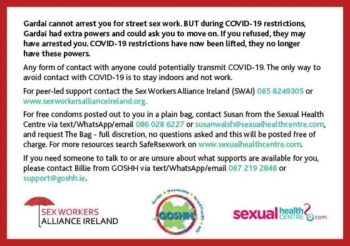
Back in July, the Sex Workers Alliance Ireland (SWAI) held a webinar to launch a new harm reduction resource we developed in collaboration with GOSHH in Limerick and Sexual Health Centre in Cork. The information card provides practical advice for anyone selling or trading sex on the street or outdoors during the pandemic and was created by a group which included current street workers, other sex workers and support workers with experience in this area.

When the pandemic started, harm reduction guidelines appeared online with advice for sex workers who continued in-person sex work out of necessity. Here in SWAI, our outreach worker Becky joined up with Billie, the support worker in GOSHH, as they realised that there was nothing available with specific information for people working on the street. More people joined the group and, in writing the guidelines, we focused on simple steps people could take to reduce the risk of COVID transmission, to protect themselves when selling sex. There is no way to guarantee safety when you’re in close contact but people still need to make money and these are just some tips for keeping yourself safer while working. The tips are also not just relevant for sex workers, they can be useful for anyone because, of course, people are still having sex even in a global pandemic! The information can be especially helpful for anyone meeting others for sex outdoors or in cars.

The leaflet is COVID-19 specific so all of the advice is focused on reducing the risk of contracting COVID but this needs to be taken into consideration alongside protecting yourself in terms of your overall health and physical safety. Sex workers are used to risk assessing and making judgements for their own safety, and often go by gut instinct. This new information isn’t supposed to override all of that and we always stress that your immediate physical safety takes priority.

On the back of the card we have included some facts about the law. We know from experience and discussions with other street workers that not everyone knows what the laws around sex work are, including the Gardaí! Since 2017, selling sex on the street is legal but paying for sex is not. It is also illegal to work indoors with other people but you are allowed to work inside alone. The Gardaí were given new powers at the start of the pandemic which allowed them to move on and even arrest people who were not complying with lockdown orders. These laws have now been rescinded but currently on-the-spot fines exist for people found breaking COVID regulations. However, you should not be getting in trouble or arrested for street working otherwise and if you are having any issues with this you can contact us for advice and support. 

SWAI is a sex-worker led organisation working towards giving a voice to people who are in sex work by choice, circumstance or coercion. We believe that sex workers know what is best for us and are best placed to advocate in the policies that affect our lives. We also work to provide support to any sex workers who need it whether they work indoor, outdoor, online or another section of the industry. We have peer support available so that you can speak to someone who has a similar experience, without any judgement. We can help with a range of issues including legal, immigration, accessing addiction or housing and homeless services, health, or if you want to look at leaving sex work and need support. 

If you want to contact us you can call Becky on: 085 824 9305 or email outreach@swai.eu

Here is a link to the resource and if you are interested in attending a webinar about this issue please get in contact with us Leaflet Print ready v2